
Why Every Young Player Needs a Change Direction Dribbling Drill
A change direction dribbling drill is one of the fastest ways to level up your game — whether you’re trying to make the A-team, earn more playing time, or just stop getting the ball taken away.
Here’s a quick look at the two moves this article covers:
| Move | Best Used For | Difficulty |
|---|---|---|
| L-Turn | Tight spaces, shielding the ball | Beginner-friendly |
| Pull-Back and Tap | Escaping pressure, 180° turns | Beginner-friendly |
Both moves can be practiced solo in a small space — all you need is a ball and a few cones.
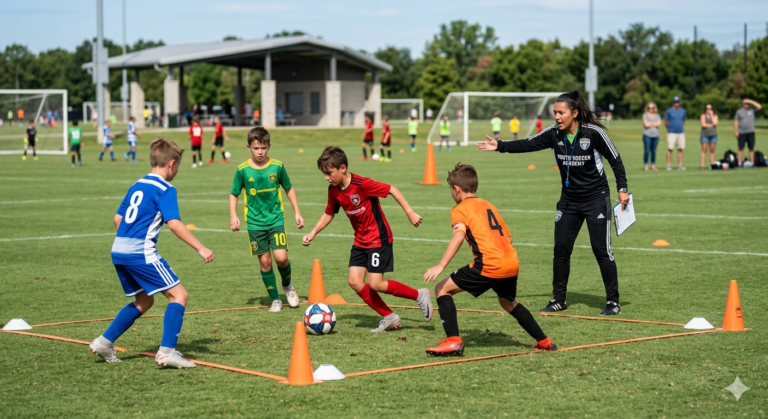
If your child plays club soccer in the Charleston or Mount Pleasant area, you’ve probably seen it happen: a player gets the ball, a defender closes in fast, and — they freeze, or they lose it. It’s frustrating, and it’s one of the most common confidence-killers for young players.
The good news? It’s totally fixable.
Changing direction while dribbling is a skill used by every position — defenders, midfielders, and strikers alike. And the players who master it early have a huge advantage. They can beat faster opponents, create space out of nothing, and stay calm under pressure.
This guide breaks down two simple but powerful change-of-direction moves, plus a step-by-step drill to practice them both.
Why Change of Direction is Your Secret Weapon
In the world of Lowcountry youth soccer, speed is great, but agility is better. We’ve all seen that one player who is incredibly fast in a straight line but struggles the moment a defender steps in their path. That is where a solid change direction dribbling drill becomes a game-changer.
When you master the ability to pivot, turn, and explode in a new direction, you become unpredictable. You aren’t just running; you’re manipulating the defender’s momentum. By learning how the best players turn on a dime, you gain an immediate offensive advantage.
Think about a match at the James Island Youth Soccer Club or a Saturday morning game in North Charleston. When a defender lunges for the ball, a quick change of direction unbalances them. While they are still recovering their footing, you are already five yards away, creating space for a pass or a shot. This explosiveness is what separates “good” players from “great” ones. It’s about having the confidence to say, “I can go anywhere on this field, and you can’t stop me.”
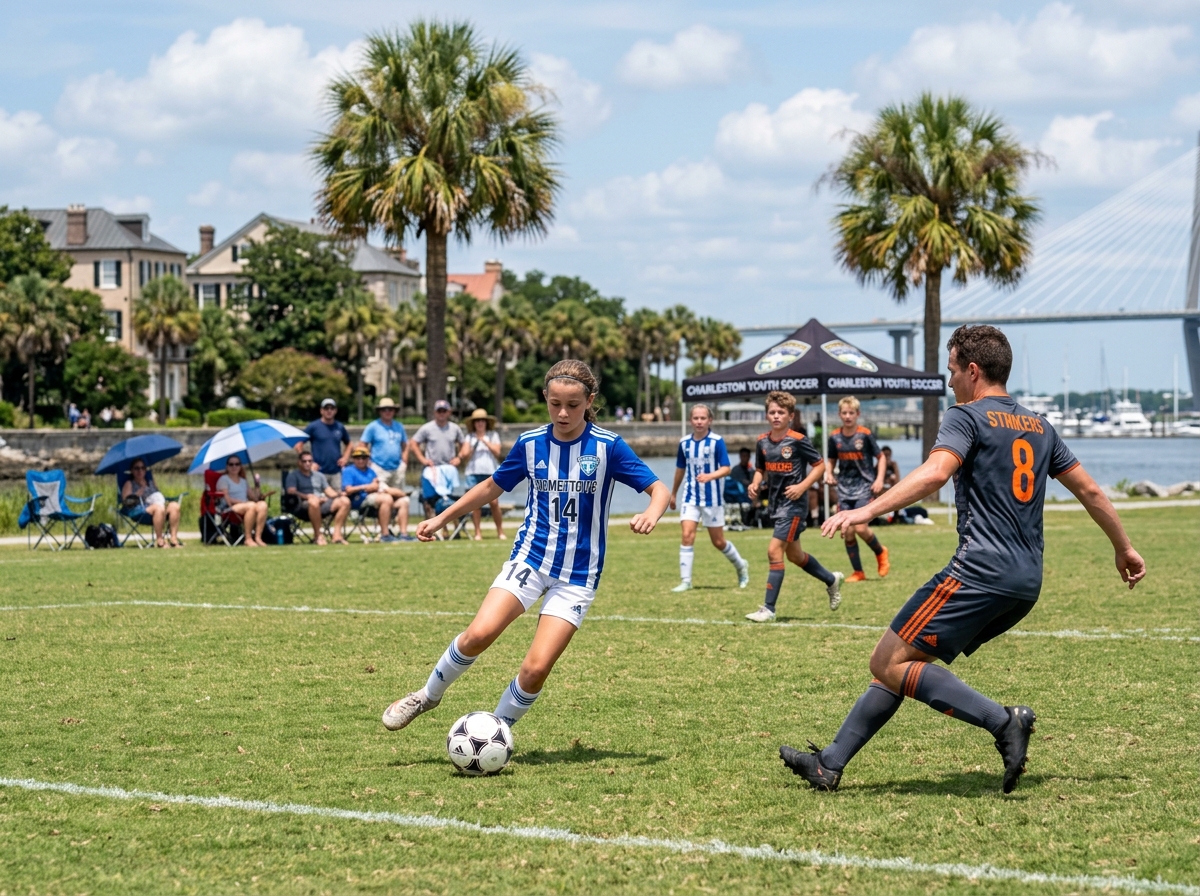
The Importance of Mastering a Change Direction Dribbling Drill
Ball-handling is arguably the most important skill a young player can develop. It’s the foundation for everything else. If you can’t control the ball under pressure, you can’t look up to find a teammate or see an open lane to the goal. You can find more tips on our soccer blog about how these fundamentals translate to game-day success.
Why is a specific change direction dribbling drill so essential?
- Tight Spaces: Modern soccer often happens in congested areas. Whether you’re a defender playing out of the back in Summerville or a striker in the box, you need to navigate tight windows.
- Game Speed: Drills help move these techniques from your “thinking brain” to your “muscle memory.” In a game, you don’t have time to think about foot placement; you just have to do it.
- Position Neutrality: Don’t think this is just for flashy wingers. Statistics show that teams that force turnovers—often by trapping players who lack change-of-direction skills—win more games. Even a center-back needs to be able to turn away from a high press to keep possession.
By practicing these moves, you learn to keep your head up. Instead of “ball-watching” (looking down at your feet), you start to scan the field, looking 3-5 yards ahead to anticipate the next move.
Two Essential Moves: The L-Turn and the Pull-Back
Before we jump into the full drill, we need to master the mechanics of the moves themselves. We always tell our players in Mount Pleasant: “Slow is smooth, and smooth is fast.” Don’t worry about doing these at a sprint yet. Focus on the foot placement and the “feel” of the ball.
The L-Turn: A Classic Change Direction Dribbling Drill
The L-Turn is one of the most effective ways to shield the ball while simultaneously moving away from a defender. It’s a 90-degree turn that looks like the letter “L” on the grass.
- The Setup: Dribble forward with your dominant foot.
- The Pull: Place the sole of your foot on top of the ball and pull it straight back behind your standing leg.
- The Push: Use the inside of the same foot to “ping” the ball behind your standing heel and out to the side.
- The Result: You’ve protected the ball with your body and changed your lane of travel.
Professionals like Neymar use variations of this move constantly to escape traps near the touchline. You can watch how Neymar changes direction to see how deceptive and quick this movement can be when perfected.
The Pull-Back and Tap: Mastering the Change Direction Dribbling Drill
The Pull-Back (sometimes called a Drag-Back) is the ultimate 180-degree escape move. It’s perfect for when you’ve dribbled into a dead end and need to get out fast.
- The Stop: Reach out and put the sole of your foot on the ball to stop its forward momentum.
- The Pull: Pull the ball back toward your body.
- The Hop: As you pull the ball back, take a small “hop” with your standing foot to get it out of the way.
- The Tap: Use the inside or outside of your foot to guide the ball in the opposite direction and accelerate away.
This move is all about the change of pace. You go from a dead stop to a sudden burst of speed, leaving the defender wondering where you went.
Step-by-Step: The “Diamond” Change of Direction Drill
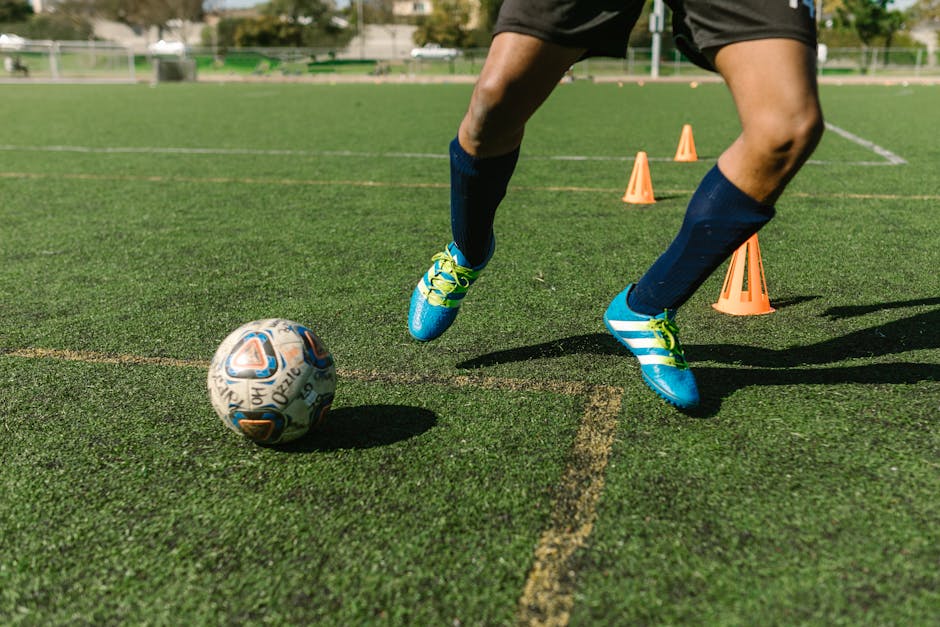
Now, let’s put it all together. This change direction dribbling drill is designed to fit in a small space—perfect for a backyard in Daniel Island or a corner of the park at Patriot’s Point. You only need a 2×4 yard space and four cones (or shoes, or water bottles!).
Equipment Needed:
- 1 Soccer Ball
- 4 Cones
- A flat surface (grass or turf)
Drill Instructions:
- Set up the Diamond: Place four cones in a diamond shape. Each cone should be about 3 yards away from the center point.
- The Approach: Start at the bottom cone (closest to you) and dribble toward the center of the diamond with small, controlled touches.
- The L-Turn: When you reach the imaginary center point, perform an L-Turn toward the left cone. Dribble around that cone and back to the center.
- The Pull-Back: Once back at the center, perform a Pull-Back and Tap to head toward the right cone. Dribble around it and return to the center.
- The Finish: From the center, use a quick burst of speed to dribble through the top cone to finish the rep.
Move Comparison Table
| Feature | L-Turn | Pull-Back |
|---|---|---|
| Angle of Turn | 90 Degrees | 180 Degrees |
| Primary Foot Surface | Sole then Inside | Sole then Inside/Outside |
| Best Game Scenario | Sideways escape from a tackle | Reversing play away from a trap |
Pro Coaching Points to Avoid Common Mistakes
As a peer-mentor who has played through the Charleston youth systems, I see the same few mistakes over and over. Avoiding these will make your change direction dribbling drill much more effective.
- Don’t Be a “Ball-Watcher”: It’s tempting to stare at your feet. Try to keep your chin up. Professional players like Arike Ogunbowale emphasize that being “good” with your handles means you can feel the ball without looking at it. Try to scan 3-5 yards ahead.
- The Athletic Stance: If you stand straight up, you’ll be slow. Keep your knees bent and stay on the balls of your feet. This lower center of gravity allows you to “explode” out of the turn.
- The “Pinky Toe” Touch: For the best control, use the area of your foot near your pinky toe for small touches. This keeps the ball close to your body, making it easier to transition into a turn.
- Change of Pace: A turn is only half the battle. The other half is the acceleration. After you finish the move, your next two steps should be a sprint. This “burst” is what actually beats the defender.
- Master the Basics First: You don’t need fancy step-overs yet. As fundamental dribbling techniques suggest, mastering the simple direction changes is what builds real game-day confidence.
Training in Charleston: How to Level Up Your Game
We are lucky to live in a place with a thriving soccer culture. Between the Mount Pleasant Recreation Department programs and the high-level club teams, there are plenty of places to play. But the real improvement happens in the “extra” hours.
Integrating a change direction dribbling drill into a weekly routine is easier than you think. You don’t need a 2-hour session.
- The 15-Minute Rule: Practice these moves for just 15 minutes a day, four days a week.
- The Routine: Spend 5 minutes on stationary ball feel (toe taps, rolls), 5 minutes on the L-Turn and Pull-Back mechanics, and 5 minutes on the Diamond Drill.
At Olly on the Ball, we believe in peer-to-peer mentoring. Sometimes, hearing a tip from someone who is currently playing in the same local leagues makes it “click” faster than hearing it from a coach on the sidelines. We focus on building that confidence so that when you step onto a field at Isle of Palms or Sullivan’s Island, you feel like the most prepared player out there.
Frequently Asked Questions about Change of Direction
How often should I practice these drills?
Consistency is better than intensity. Practicing for 15 minutes daily is much more effective than doing one 2-hour session on the weekend. You want your feet to become so familiar with the ball that the moves happen automatically.
What equipment do I need for a change direction dribbling drill?
You don’t need expensive gear. A soccer ball and four markers (cones, shoes, or even socks) are plenty. The most important “equipment” is a flat surface and a positive attitude!
Can these moves help me beat faster defenders?
Absolutely. In fact, change-of-direction moves are the best way to beat faster players. A fast defender relies on their straight-line speed. If you change direction suddenly, they have to stop their momentum and restart it, which gives you a 1-2 second head start.
Conclusion
Mastering a change direction dribbling drill isn’t just about footwork; it’s about building the confidence to take control of the game. When you know you can escape any situation with an L-Turn or a Pull-Back, you play with more freedom and joy.
At Olly on the Ball, we are dedicated to the Charleston soccer community. We want to help young players in Mount Pleasant, Summerville, and across the Lowcountry fall in love with the game by mastering the fundamental skills that make soccer fun.
Ready to take your game to the next level with personalized coaching? Whether you want to sharpen your turns or master your shooting, I’m here to help.
Book a Private Session today and let’s get to work!