
Why Kids Soccer Mindset Development Is the Secret to Long-Term Success
Kids soccer mindset development is one of the most powerful — and most overlooked — factors in whether a young player thrives or gives up the game entirely.
Here’s a quick overview of what it means and why it matters:
- What it is: Teaching young players to believe their abilities can grow through effort, practice, and learning from mistakes — rather than thinking talent is fixed
- Why it matters: Nearly half of kids who quit youth soccer cite performance pressure as a key reason. Mindset training directly addresses this
- Who it’s for: Players of any age or skill level — from first-time rec league kids in Mount Pleasant to competitive club players chasing an A-team spot
- What it looks like in practice: Effort-focused praise, normalizing mistakes, simple breathing tools, growth-oriented goals, and a supportive team culture
- The bottom line: Research shows kids praised for effort improved performance scores by 30%, while kids praised for talent actually declined by 20%
Think about this for a second.
Your child misses a penalty kick. Do they think “I need to practice that more” — or “I’m just not good at soccer”?
That one thought, in that one moment, tells you almost everything about where their mindset is right now. And the good news? Mindset is completely trainable.
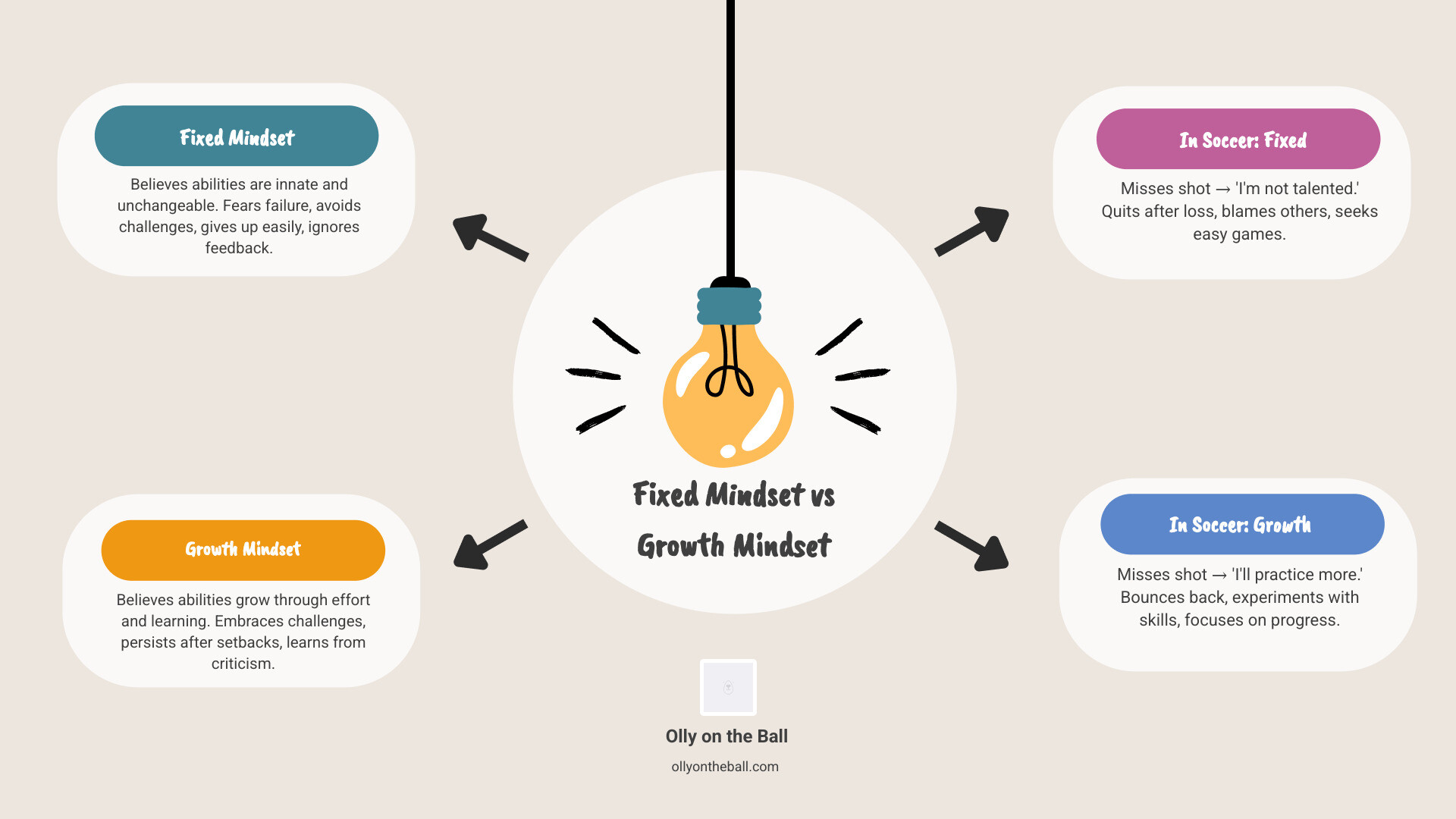
Psychologist Carol Dweck’s landmark research identified two types of mindsets: a fixed mindset (the belief that ability is set in stone) and a growth mindset (the belief that ability builds through hard work and persistence). In youth soccer, the difference between these two shows up constantly — on every missed shot, every tough loss, every piece of coaching feedback.
Players with a growth mindset hear a coach’s correction and think: “Coach is helping me get better.” Players with a fixed mindset hear the same words and think: “Coach doesn’t think I’m good enough.”
Same words. Completely different outcomes.
At Olly on the Ball, we work with young players right here in the Charleston and Mount Pleasant area — and we see this play out on the pitch every single week. The players who grow the fastest aren’t always the most naturally talented. They’re the ones who keep going after a mistake.
This guide breaks down exactly how to build that mental edge — for coaches, parents, and players alike.
Why Kids Soccer Mindset Development is the Secret to Success
When we talk about kids soccer mindset development, we aren’t just talking about being “tough.” We are talking about a scientific approach to how a child’s brain processes challenges. In youth sports, natural talent and physical ability are often celebrated above all else. But in reality, it’s not just talent that determines long-term success—it’s mindset.

Famed Stanford researcher Dr. Carol Dweck has found that when it comes to performance, there are two types of ‘mindsets’. In her book Mindset, she explains that a “fixed” mindset creates a ceiling. If a player believes they are born with a certain amount of talent, they become terrified of failing because a mistake “proves” they aren’t actually talented.
Conversely, a growth mindset makes a player “coachable.” When a player believes their skills are like a muscle that grows with work, they stop fearing the sidelines and start craving the challenge.
Fixed vs. Growth Mindset in Youth Soccer
| Trait | Fixed Mindset | Growth Mindset |
|---|---|---|
| View of Talent | Something you are born with. | Something developed through effort. |
| Reaction to Failure | “I’m not good at this.” | “What can I learn from this?” |
| Response to Coaching | Takes criticism personally. | Sees feedback as a tool to improve. |
| Effort | Seen as a sign of low ability. | Seen as the path to mastery. |
| Challenges | Avoids them to look “smart.” | Embraces them to get better. |
Developing this resilience is why we focus so heavily on the mental game at Olly on the Ball. Whether we are training at a park in Daniel Island or a backyard in Summerville, our goal is to ensure the player leaves with more than just better footwork—they leave with a belief in their own potential. You can learn more about our training services to see how we integrate these concepts into every drill.
Practical Strategies for Kids Soccer Mindset Development
So, how do we actually “build” a mindset? It starts with the language used by the adults in the car and on the sidelines.
One of the most effective tools is process-oriented praise. Instead of saying “You’re a natural,” try saying “I loved how hard you worked to win the ball back after you lost it.” John O’Sullivan, founder of the Changing the Game Project, often cites Dweck’s work, noting that when we praise intelligence or “giftedness,” we actually make kids more fragile.
Another game-changer is the “Not Yet” attitude. If a player says, “I can’t use my left foot,” we teach them to add one word: “I can’t use my left foot yet.” This small shift acknowledges that mastery is a journey, not a destination.
Coaches and parents can also use the “Positive Sandwich” method for feedback:
- The Bread: Start with something they did well (e.g., “Great vision on that pass!”).
- The Meat: Provide the correction (e.g., “Next time, try to lock your ankle to keep the ball on the ground.”).
- The Bread: End with encouragement (e.g., “Keep trying that, you’re almost there!”).
This keeps the player’s confidence high while giving them the technical tools they need to grow.
A 30-Day Plan for Kids Soccer Mindset Development
Mindset isn’t a one-time speech; it’s a daily habit. To help our Charleston and Mount Pleasant players, we recommend a simple 30-day structure to rewire how they think about the game.
- Days 1-10: The Effort Audit. Every day after practice or a solo session, the player writes down one thing they worked hard on. Not one thing they did perfectly—one thing that required effort.
- Days 11-20: Mistake Mastery. The player identifies one mistake they made and writes down what it taught them. For example: “I got tackled because I didn’t scan. Now I know to look over my shoulder.”
- Days 21-30: The “Next Play” Mantra. During games or drills, if a mistake happens, the player practices a physical reset (like adjusting their socks or a deep breath) and says “Next play.”
Consistency is key here. By using Changing the Game Project recommended resources, parents can find even more tools to support this journey. Tracking progress in a journal helps players see that their skills are indeed growing, which builds an internal, unshakable confidence.
Prioritizing Development Over the Scoreboard
In the hyper-competitive youth soccer scene of the Lowcountry, it is easy to get caught up in the score. However, prioritizing winning over development is a recipe for burnout.
Consider the statistics: High school athletes have a 7% chance of obtaining a college sports scholarship, and less than 1% will ever secure a professional contract. If the only “win” is the final score or a trophy, most kids will end up feeling like failures.
When we prioritize development, we celebrate:
- Trying a new move in a game, even if it doesn’t work.
- Communicating with teammates.
- Showing up early to get extra touches.
Nearly half of quitting youth soccer players cite performance pressure as the cause. By shifting the focus to individual growth, we remove that “fear of the scoreboard” and replace it with the joy of the game. You can check out Olly’s blog for more stories on how focusing on the process leads to better results in the long run anyway!
Mental Tools for the Pitch: Visualization and Breathing
The best players in the world use psychological tools to stay calm under pressure, and there is no reason young players in Charleston can’t do the same.
1. The 5-5-5 Breathing Technique:
When a player feels “butterflies” before a big game at James Island or a penalty shootout in Summerville, their body is in “fight or flight” mode.
- Inhale for 5 seconds.
- Hold for 5 seconds.
- Exhale for 5 seconds.
This simple cycle resets the nervous system and brings focus back to the present moment.
2. Visualization (Mental Rehearsal):
Encourage your player to spend five minutes before bed imagining themselves succeeding. Not just scoring goals, but handling a bad pass with a good touch, or winning a 50/50 ball. This builds “mental muscle memory.”
3. Positive Self-Talk:
Replace “I hope I don’t mess up” with “I am prepared and I’ll give it my best.” This isn’t just “fluff”—it changes the chemistry of the brain to be more aggressive and decisive. You can read more about Olly’s story to see how these mental habits helped him compete at a high level.
Overcoming Fear and Building Resilience
Fear of failure is the #1 reason for dropout in youth soccer. As adults, we often accidentally double the likelihood a child will quit by putting too much pressure on the outcome.
To build resilience, we must normalize mistakes. We tell our players: “If you aren’t making mistakes, you aren’t trying hard enough things.” When a player misses a shot, we don’t want them looking at the sidelines with a “sorry” face. We want them thinking about how to get the next ball.
Peer mentorship is a huge part of this. At Olly on the Ball, because I am a 16-year-old player myself, I can relate to that feeling of a “heavy touch” or a bad game. When kids see a peer they respect acknowledge a mistake and keep playing, it gives them permission to do the same. This creates a supportive culture where risk-taking is rewarded over playing it “safe.”
As John O’Sullivan from the Changing the Game Project emphasizes, the goal is to create a “task-involving” climate. This means success is defined by the player’s own improvement, not by being better than the kid next to them.
Frequently Asked Questions about Youth Soccer Mindset
How do I help my child handle a tough loss?
Focus on the “teachable moments.” Ask: “What did you do well today that you’re proud of?” and “What is one thing we can work on this week to be better next time?” Avoid critiquing their play during the “ride home”—let that be a safe space.
What is the best way to praise my young player?
Praise the effort, not the outcome. Instead of “You’re the best player on the team,” try “I noticed how much you were scanning the field today—that really helped your passing!” This links their success to an action they can control.
How can I tell if my child has a fixed mindset?
Look for signs like:
- Giving up easily when a drill gets hard.
- Making excuses (“The grass was too long,” “The ref was bad”).
- Getting very upset over a single mistake.
- Avoiding playing against “better” kids because they are afraid to look bad.
Conclusion
At the end of the day, soccer is a game. It’s meant to be fun, challenging, and a way to build character that lasts long after the cleats are hung up. By focusing on kids soccer mindset development, we aren’t just building better soccer players—we are building resilient, confident young people who know how to handle whatever life throws at them.
Whether you are in Isle of Palms, Sullivan’s Island, or North Charleston, Olly on the Ball is here to help your child master the fundamentals and find their “mental edge.” We focus on the pillars of skill, confidence, and a genuine love for the game.
Ready to see the difference a growth mindset can make?