
Why Soccer IQ Is the Secret Weapon Every Young Player Needs
Want to improve soccer IQ kids in a way that actually shows up on the pitch? Here’s the short answer:
The fastest ways to improve soccer IQ in kids are:
- Play small-sided games (3v3, 4v4) — more touches, faster decisions
- Rotate positions — builds empathy for teammates and tactical awareness
- Watch and analyze games — pause, rewind, and ask “what would you do here?”
- Practice scanning — check shoulders before every pass or touch
- Focus on one or two concepts per season — depth beats breadth every time
- Use cognitive training tools — apps, VR, and video games on higher difficulty
- Encourage self-reflection — ask open-ended questions after every game
Soccer is a thinking game as much as a physical one.
Your child can have lightning-fast feet and still lose the ball if they can’t read what’s happening around them. That split-second ability to anticipate, position, and decide — before the ball even arrives — is what coaches call soccer IQ.
And here’s the exciting part: it’s completely trainable.
Whether your child is just starting out in a rec league or pushing for a sport on a competitive club team here in Charleston or Mount Pleasant, sharpening their game intelligence can make a massive difference in their confidence and performance.
In this guide, we’re breaking down 10 practical, proven ways you can help your young player think faster, read the game better, and consistently outsmart the competition — no matter their current skill level.
What is Soccer IQ and Why It Matters for Young Players
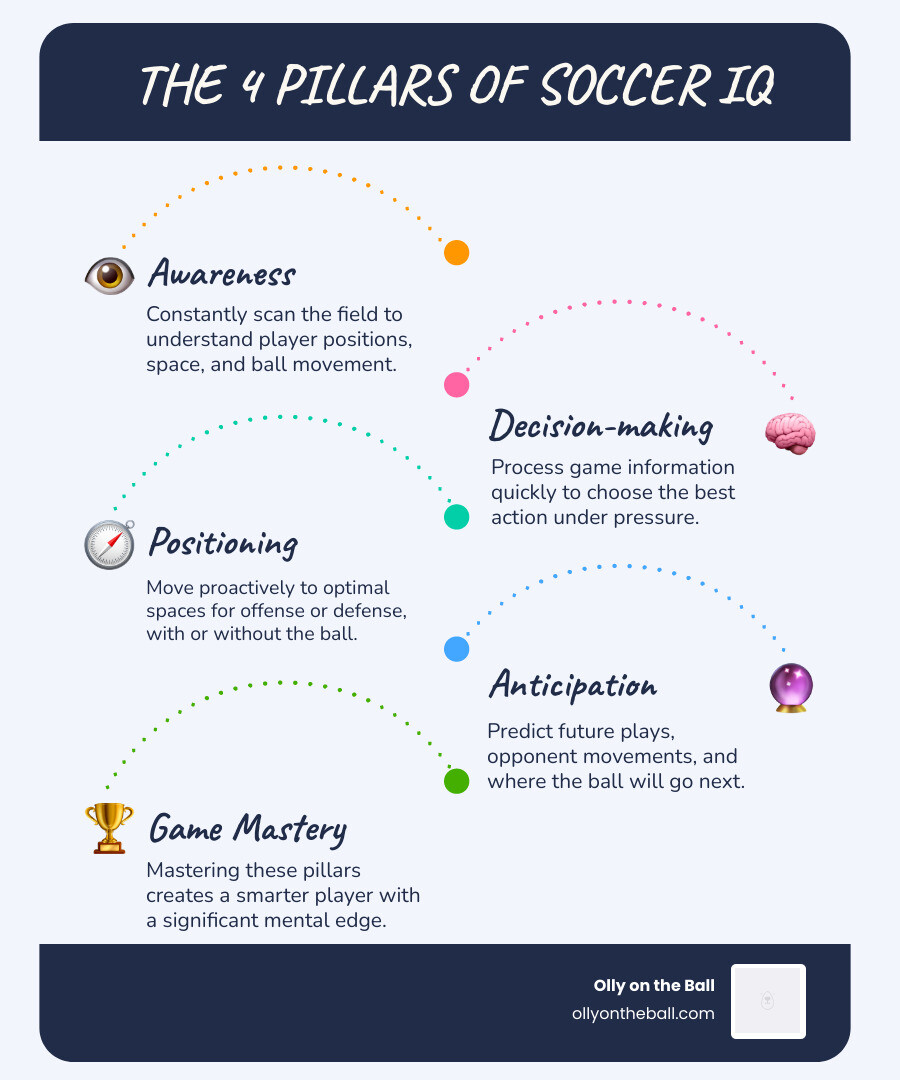
When we talk about “Soccer IQ,” we aren’t talking about how well a kid can juggle a ball in their backyard. We are talking about game intelligence. It’s the ability to read the game, anticipate what’s going to happen next, and make the right choice under pressure.
Think of it as the “software” running the “hardware” (the physical skills). A player with high soccer IQ knows where to be even when they don’t have the ball. They see the passing lane before it opens and recognize when a teammate needs support. In the environment of Lowcountry youth soccer, from the fields at Daniel Island to the competitive hubs in Mount Pleasant, this mental edge is often what separates the starters from the bench.
Developing this intelligence also keeps kids safer. Players who are aware of their surroundings are less likely to be caught in dangerous collisions. You can Read More about Youth Sports Safety to understand how awareness contributes to long-term health on the field. A smart player is a confident player. When a child understands why they are making a move, they play with more conviction and less hesitation.
The Core Components to Improve Soccer IQ Kids
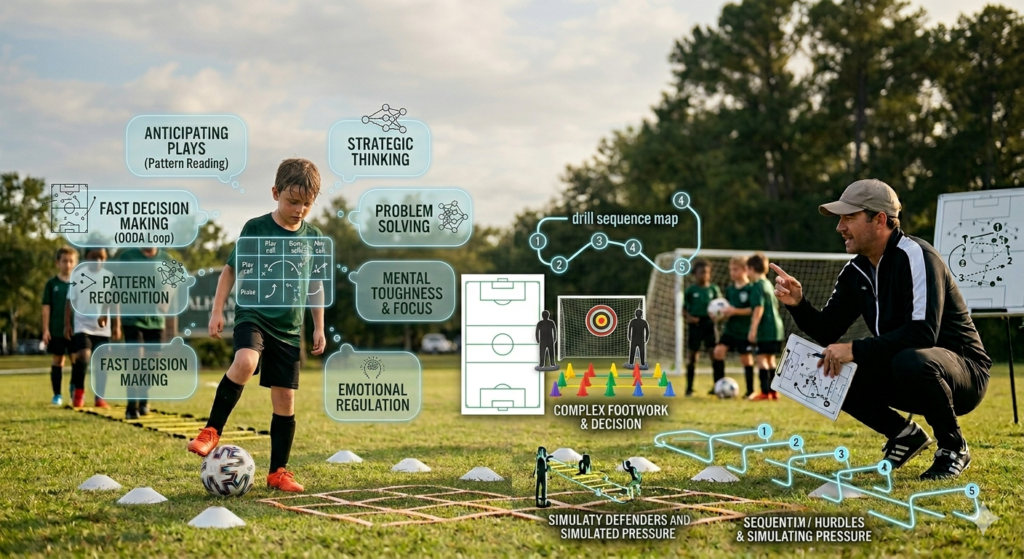
To effectively improve soccer IQ kids need to focus on a few specific mental “muscles”:
- Scanning: This is the habit of “checking your shoulders.” Elite players scan the field every few seconds to build a mental map of where everyone is.
- Pattern Recognition: Soccer is full of recurring scenarios (like a 2v1 on the wing). High IQ players recognize these patterns early and know the “solution.”
- Off-Ball Movement: About 95% of a match is spent without the ball. Knowing how to move into space to help a teammate is a hallmark of intelligence.
- Communication: Smart players talk. They give instructions like “man on” or “turn,” helping the whole team stay organized.
- Transition Play: Recognizing the exact moment the ball is lost or won and reacting instantly.
Why Physical Skill Isn’t Enough
We’ve all seen the “track star” on the pitch—the kid who is faster and stronger than everyone else but struggles to make an impact against a well-organized defense. Athleticism is great, but it has a ceiling. As players get older and move into U12 and U14 brackets in Charleston, the physical gap closes.
Intelligence, however, has no ceiling. A player who can “outthink” the opponent will always beat a player who can only “outrun” them. We call these “mental sprints.” While the body might get tired, a sharp mind can find the one pass that unlocks a game. In the competitive landscape of South Carolina youth soccer, being “soccer smart” is the ultimate equalizer for players who might not be the biggest or fastest on the team.
Proven Methods to Improve Soccer IQ Kids on the Pitch
The best classroom for soccer intelligence is the game itself, but not just any game. Standard 11v11 matches for young kids often result in long periods where they don’t touch the ball or have to make a decision. To truly improve soccer IQ kids should spend as much time as possible in small-sided environments.
Small-sided games (SSGs) like 3v3 or 4v4 are tactical goldmines. Because there are fewer players, every child is constantly involved. They can’t “hide” on the wing. They are forced to defend, attack, and transition every single minute.
| Feature | 3v3 Small-Sided | 11v11 Full Field |
|---|---|---|
| Ball Touches | High (Every 10-20 seconds) | Low (Can go minutes without a touch) |
| Decision Points | Constant | Intermittent |
| 1v1 Opportunities | Frequent | Rare |
| Tactical Role | All-around (Attack & Defend) | Position-locked |
Using Small-Sided Games to Boost Awareness
In a 3v3 or 4v4 game, the “pitch” is smaller, which means the pressure is higher. Kids have to learn how to find “width” and “depth” in tight spaces. If they don’t scan, they lose the ball immediately. This environment creates a “feedback loop” where the game itself teaches the lesson. If a player stands still, their team loses the ball. If they move into space, they get a pass. This type of problem-solving is exactly how we build tactical flexibility.
The Importance of Positional Rotation
One of the biggest mistakes coaches and parents make is “pigeonholing” a child into one position too early. To develop a high soccer IQ, a child needs to understand the whole game.
- Defenders who have played striker understand the runs a forward wants to make.
- Strikers who have played defense understand how to press and where a defender is most vulnerable.
- Midfielders need to experience both ends to learn how to link play effectively.
Rotating positions builds “tactical empathy.” It helps a child see the game through their teammates’ eyes. For a deeper dive into the science of this, you can check out What Is Soccer IQ and How Can You Improve It? to see how varied experiences shape the brain.
Off-Field Habits to Sharpen the Soccer Brain
Training doesn’t stop when we leave the fields at Isle of Palms or James Island. Some of the biggest leaps in soccer intelligence happen in the living room.
Watching Pro Games and Video Analysis
Watching soccer is a skill in itself. Instead of just watching the ball, encourage your child to watch a specific player who plays their position.
- Watch the Charleston Battery: Take them to a local pro game! Seeing the speed of play in person is eye-opening.
- The “Pause and Predict” Method: When watching a match on TV, pause the game and ask, “Where should the left-back move now?” or “What is the best pass here?”
- Self-Reflection: If you have video of your child’s game, watch it together. Focus on the positives first. Ask them what they saw in the moment versus what they see now on the screen.
A great resource for starting this journey at a very young age is the book Soccer Starts at Home by Tom Byer, which emphasizes that the home environment is the first “academy.”
Cognitive Training and Modern Tech Tools
We live in an age where “brain training” for soccer is a real thing. Tools like Soccer IntelliGym or VR programs like Be Your Best are designed to improve “working memory” and “pattern recognition.” These tools simulate the chaos of a match, forcing the brain to make hundreds of decisions in a 20-minute session.
Even playing FIFA (or EA Sports FC) can help, provided it’s done right. Encourage your child to play on a harder difficulty where they have to actually “build up” play rather than just sprinting down the wing. It helps them visualize formations and passing triangles. For more on the mental side, you can Download the FREE E-BOOK “The Most Important Skill In Youth Soccer”.
Learning the Principles of Play
You don’t need a coaching license to teach the basics. Start with these simple concepts:
- Attacking Width and Depth: Making the field “big” to stretch the defense.
- Defensive Delay: Not diving in, but slowing the attacker down.
- Support: Always giving the person with the ball at least two passing options.
- Penetration: Knowing when to play the “killer pass” versus keeping possession.
How Parents Can Support Development at Home
You are your child’s first coach. You don’t need to be a pro to help improve soccer IQ kids in your own backyard in Mount Pleasant or Summerville. The key is to move away from “drills” and toward “challenges.”
Simple Drills to Improve Soccer IQ Kids
Instead of just kicking the ball back and forth, try these variations:
- The Scanning Game: While passing with your child, hold up a certain number of fingers or a colored cone behind your back. They have to shout out the number/color before they receive the ball. This forces them to look away from the ball.
- Give-and-Go: Practice the “wall pass.” Pass to them, have them one-touch it back and immediately move to a new space to receive it again.
- Shadow Play: Have them move around the yard as if they are defending an invisible player. Call out “Ball is left!” or “Ball is behind you!” and have them adjust their body shape.
Tracking Progress and Metrics
How do you know if it’s working? Look for these signs during their next game at the Isle of Palms recreation fields:
- Scanning Frequency: Are they looking over their shoulder before the ball arrives?
- First Touch Direction: Is their first touch taking them away from pressure and toward space?
- Pass Completion: Are they making “smart” passes rather than just “kicking it away”?
- Communication: Are they starting to lead their teammates?
Set SMART goals (Specific, Measurable, Achievable, Relevant, Time-bound). For example: “I will scan my shoulders 5 times in the first half of Saturday’s game.” Celebrate these small wins—they are the building blocks of a great player.
Frequently Asked Questions about Soccer IQ
At what age should kids start developing soccer IQ?
While the heavy tactical stuff usually waits until age 11 or 12, foundational awareness starts as early as age 5. At the youngest ages, it’s about “creative play”—learning how to move and share. By ages 8-10, we start introducing basic positioning and the idea of “finding space.”
How long does it take to see improvements in soccer intelligence?
Soccer IQ is a compounding skill. While you might see a “lightbulb moment” in a single 6-week training block, true mastery takes years of game experience. Consistency is key. A child who watches one pro game a week and practices scanning for 10 minutes a day will look like a completely different player in three months.
What are the signs that my child has a high soccer IQ?
A high-IQ player often looks like they are “playing in slow motion.” They aren’t rushing because they already know where the ball is going. Signs include:
- Intercepting passes (anticipation)
- Being in the right place to score (positioning)
- Consistently finding open teammates
- Staying calm when a defender presses them
Conclusion
At Olly on the Ball, we believe that every child in Charleston and Mount Pleasant has the potential to be a “smart” player. Our peer-to-peer mentoring approach is designed to build these exact skills. Because Olly is actively playing at a high level, he can relate to the split-second decisions your child faces on the pitch.
We don’t just teach kids how to kick a ball; we teach them how to play the game. From mastering the fundamental skills to building the confidence to lead a team, our goal is to foster a lifelong love for soccer.
Ready to give your child the mental edge they need to dominate? Whether you’re in Daniel Island, North Charleston, or Sullivan’s Island, we’re here to help.