
Mastering Advanced Soccer Skills Youth: The Path to Elite Play
When we talk about advanced soccer skills youth players need to reach the next level, we aren’t just talking about flashy tricks for social media. We are talking about functional movements that work under the high pressure of a real match at local fields like those at the Mount Pleasant Danny Jones Complex or James Island Youth Soccer Club.
At this stage, ball control must become second nature. A player’s “first touch” is often referred to in the coaching world as first touch football. It’s the ability to receive the ball with such control that it immediately sets up the next move—whether that’s a pass, a shot, or a dribble. Without a clean first touch, a player is constantly reacting to the ball rather than dictating the game.
Beyond the touch, mastering advanced soccer skills involves:
- Shielding: Using your body as a barrier between the opponent and the ball.
- Body Feints: Using shoulder drops and hip movements to “sell” a direction to a defender without even touching the ball.
- Scanning: Looking over the shoulder before receiving the ball to understand where the space and the defenders are.
Progressing from Dribbling to Advanced Shielding
Moving from basic cone weaving to advanced game-play requires a shift in mindset. In our sessions around Charleston and Mount Pleasant, we emphasize that dribbling is like handwriting—it’s unique to every player. However, there are “alphabet” moves every elite player must know.
The Step-Over is a classic for a reason. By circling the foot around the ball, a player masks their true intention, forcing the defender to shift their weight. Once that defender bites, the attacker explodes in the opposite direction.
Another essential is the Cruyff Turn, named after the legendary Johan Cruyff. This move involves faking a cross or shot, then using the inside of the foot to hook the ball behind the standing leg. It is one of the most effective ways to escape a defender who is tight on your back. For younger players in the U8-U12 range, we also focus on the “Nutmeg”—passing the ball through a defender’s legs. While it’s fun and a bit of a crowd-pleaser, it teaches a vital lesson: always look for the “windows” of space a defender leaves open.
Developing Superior Passing and Shooting Techniques
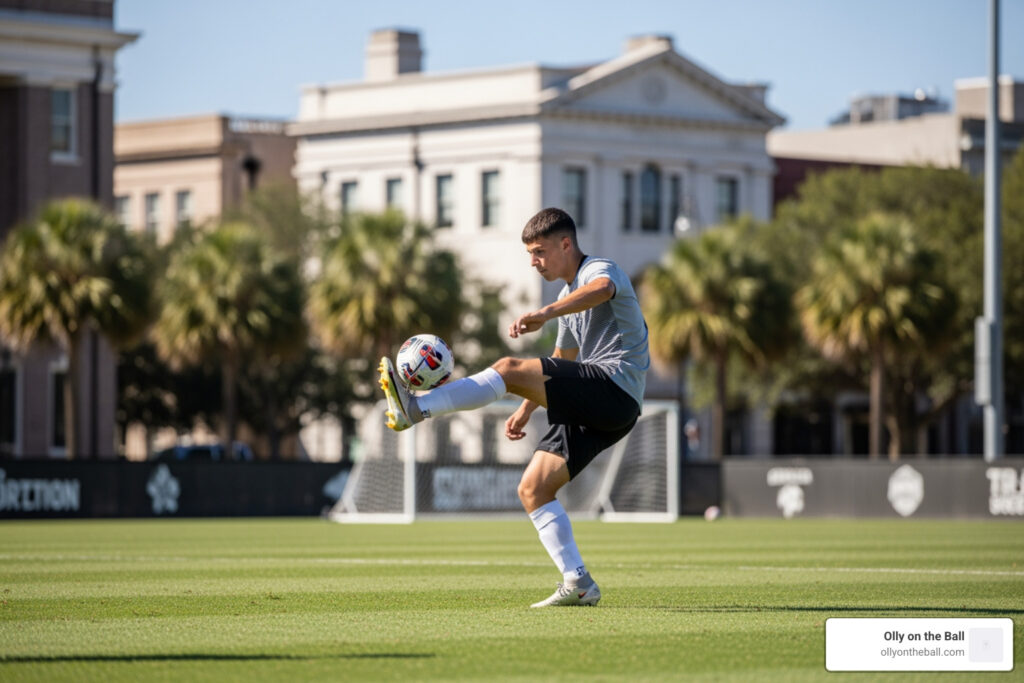
To dominate the midfield third, a youth player must move beyond the simple “push pass.” Advanced passing involves changing the trajectory and spin of the ball.
- Bending Passes: Using the inside or outside of the boot to curve the ball around a defender.
- Chipping: Getting under the ball to loft it over a sliding tackle or a goalkeeper.
- The Through Ball: This is a “weight-sensitive” pass played into space for a teammate to run onto.
When it comes to shooting, we focus on the Instep Drive for power and the Curler for accuracy. We also believe in the “weak foot” philosophy. A player who can only use one foot is only 50% of a player. By incorporating passing drills that force the use of the non-dominant foot, we help kids become unpredictable and twice as dangerous on the pitch.
Building Defensive Dominance and Soccer IQ
Defense isn’t just about kicking the ball away; it’s a mental game of chess. Great defenders use angles, distance, and anticipation rather than just raw speed. In our training, we use the Press & Cue Drill to teach players exactly when to “hunt” the ball.
Advanced Soccer Skills Youth: Defensive Positioning and Pressing
The secret to elite defending is deceleration. Many young players sprint at an attacker only to be easily bypassed because they couldn’t stop in time. We teach players to “close the gap” quickly but then slow down 2-3 yards away from the attacker. By adopting a side-on body shape with knees bent, the defender can guide the attacker toward the sidelines and away from the “danger zone” in front of the goal.
Key defensive points we cover:
- Pressing in Packs: Understanding how to coordinate with teammates to trap an opponent.
- Closing Speed: The explosive burst needed to shut down a player’s time on the ball.
- Tactical Cues: Reading an attacker’s heavy touch or a backwards pass as a signal to press high.
Decision-Making Under Pressure and Game Awareness
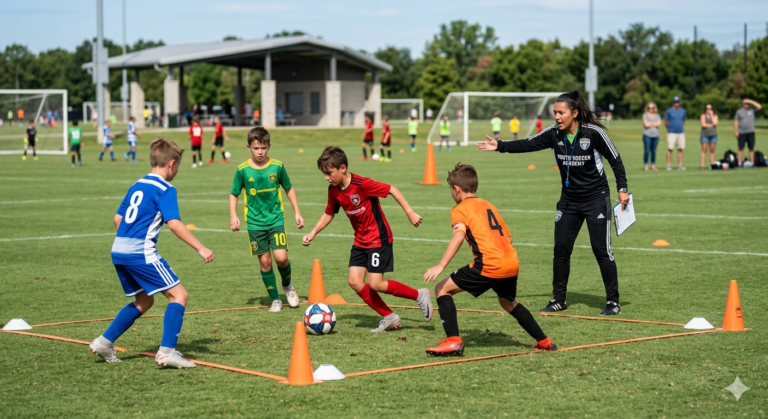
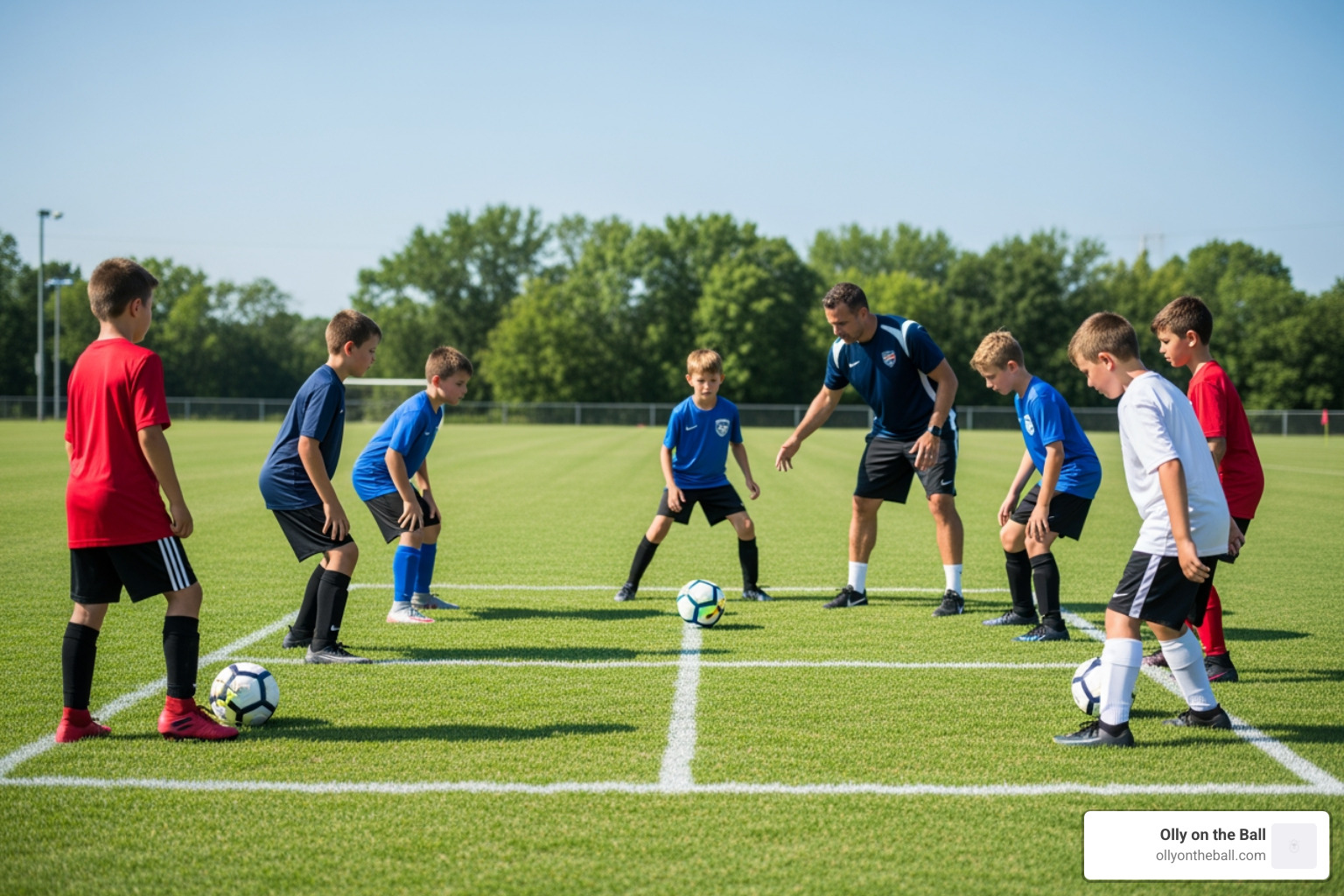
Soccer IQ is the ability to make the right choice in a split second. We build this through “mini-games”—small-sided scenarios like 1v1s, 2v1s, or 3v2 overloads. These games force players to decide: Should I dribble to attract pressure? Should I pass to the open man? Or should I protect the ball and wait for support?
Scanning is the foundation of this awareness. We encourage players to “take a picture” of the field every few seconds. This habit, which we discuss frequently on our training blog, allows a player to know their next move before the ball even reaches their feet.
Position-Specific Training and Physical Fitness
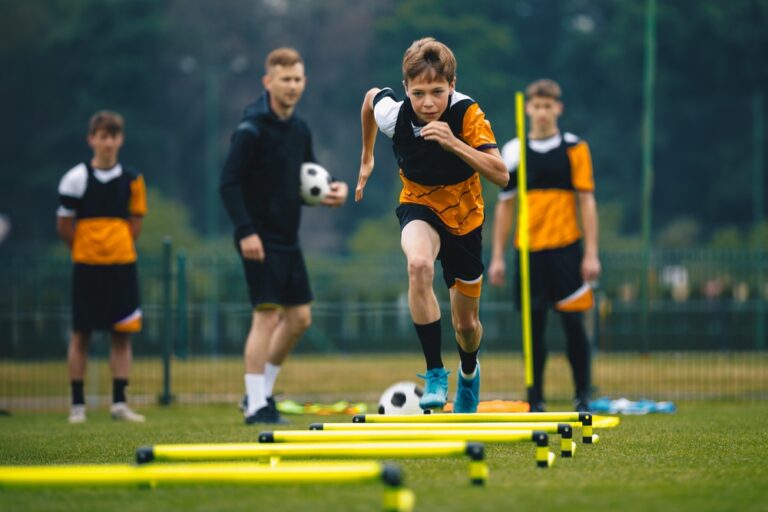
As players grow, their roles on the field become more specialized. A striker needs different “tools” than a center-back. However, all advanced soccer skills youth players develop must be supported by a high level of soccer fitness.
Advanced Soccer Skills Youth: Goalkeeping and Distribution
Goalkeeping is about more than just spectacular dives. Modern keepers are the “eleventh outfield player.” They need to be comfortable with their feet and have excellent distribution.
Our goalkeeping focus includes:
- Narrowing the Angle: Moving off the line to make the goal look smaller to the striker.
- Handling High Balls: Timing the jump and using the correct “W” hand grip.
- The Goalkeeper’s Circuit: A series of rapid-fire saves and footwork drills to improve reaction speed.
Midfield Penetration and Forward Finishing
Midfielders are the engines of the team. They must master the art of the “penetrative pass”—a ball that breaks the opponent’s defensive lines. We use drills that simulate the “spine” of the team, teaching midfielders how to find a striker’s feet or play a ball into the “second six yards” for a tap-in.
For forwards, we focus on Clinical Finishing. This includes volleys, headers, and one-touch shots. We use shooting drills that mimic match situations, such as receiving a cross while under pressure from a defender.

The Power of Peer Mentorship in Charleston
There is something special about the soccer community here in the Lowcountry. From the energy at a Charleston Battery match to the Saturday morning buzz at the Isle of Palms recreation fields, soccer is part of our DNA.
At Olly on the Ball, we believe the best way to learn is from someone who is currently “in the trenches.” As a 16-year-old competitive player, I don’t just tell my students what to do; I show them. This peer-to-peer connection builds a level of trust and confidence that is hard to find in traditional coaching environments. We draw inspiration from the Tony Carr Academy methods, which emphasize that a player’s technique is the foundation of their confidence.
Why Local Training Matters in the Lowcountry
Training locally in Charleston, Mount Pleasant, and Daniel Island means we understand the specific challenges and opportunities our players face. Whether your child is aiming for an ODP (Olympic Development Program) spot or just wants to be the best player on their school team, having a mentor who knows the local clubs and coaches makes a huge difference. Our mission is to foster a love for the game that lasts a lifetime.
Structuring the Perfect Solo Practice Session
You don’t need a full team to get better. In fact, most of the “magic” happens when no one is watching. A simple wall can be a player’s best friend. Wall work provides unbiased feedback—if you play a bad pass, the wall gives you a bad return.
A great 30-minute solo session looks like this:
- Juggling (5 mins): Focus on using all parts of the feet, thighs, and chest.
- Wall Passing (10 mins): One-touch and two-touch passing with both feet.
- Cone Weaves (10 mins): High-speed dribbling through tight spaces.
- Goal Setting (5 mins): Reflecting on what went well and what to improve tomorrow.
For more tips on how to structure your home training, check out our services page.
Frequently Asked Questions about Advanced Soccer Skills
How long does it take to see results with advanced training?
While every child is different, consistency is the magic ingredient. With focused practice 3–4 times per week, noticeable improvements in ball control, speed of thought, and overall confidence are typically seen in 6–8 weeks. It’s about building muscle memory through repetition.
What is the best age to start learning advanced techniques?
Fundamentals like dribbling and shooting should start as soon as a child picks up a ball. however, the “Golden Age of Learning” is generally between 9 and 14 years old. During this window, children are highly “plastic” in their learning—they can soak up complex feints, tactical positioning, and advanced techniques much faster than at any other time in their lives.
Can my child improve advanced skills without a full team?
Absolutely. In fact, many professional players spent hours as kids playing against a garage door or in a small backyard. Solo drills like juggling, “toe touches,” and “foundation” drills are essential for mastering advanced soccer skills youth players need to stand out. Small-group training or 1-on-1 sessions are also fantastic for refining these skills without the chaos of a 20-person team practice.
Conclusion
The journey from a recreational player to a standout athlete is paved with sweat, repetition, and the right guidance. Whether we are training under the lights in North Charleston or on the grass in Sullivan’s Island, our goal at Olly on the Ball is to make every session the highlight of a player’s week.
Mastering advanced soccer skills youth players need isn’t just about winning games—it’s about building the character, discipline, and confidence that stays with a child long after they leave the pitch. Ready to take the next step? Book a Private Session today and let’s get to work!