
The Golden Age: Why Soccer Fundamentals for Kids Matter
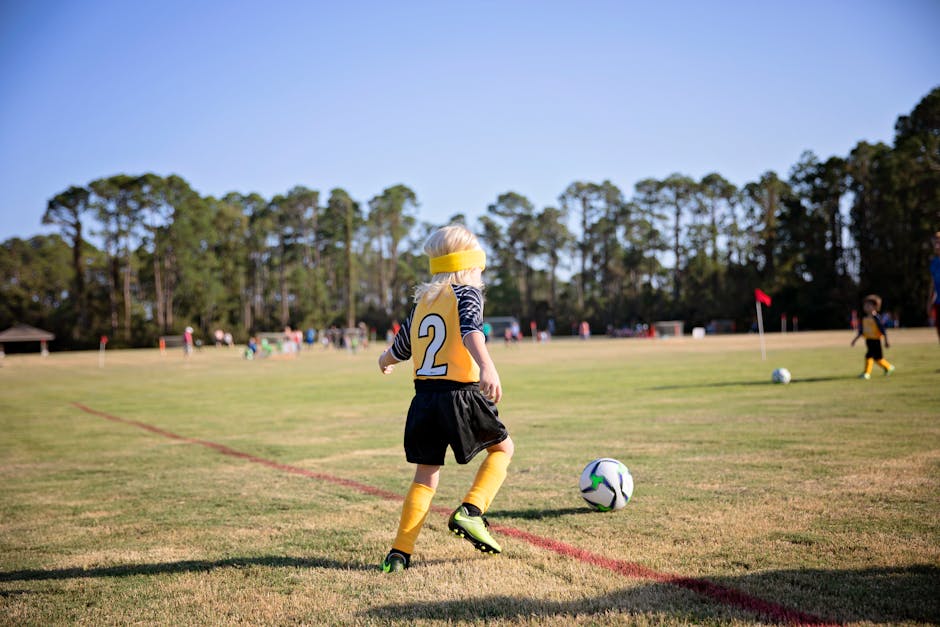
In youth sports, there is a specific window known as the “Golden Age of Learning.” This typically spans from ages 6 to 12. During this stage, children are like sponges; their motor skills are developing rapidly, and they are highly capable of picking up the technical “feel” for the ball. This is why focusing on soccer fundamentals for kids during this period is so critical. When we talk about the Golden Age, we are looking at a time when the brain’s neuroplasticity is at its peak for movement patterns. If a child learns how to properly strike a ball or change direction with balance now, those patterns become permanent.
According to Long-Term Player Development (LTPD) principles, the goal for players under 12 isn’t to master complex tactics or worry about league standings. Instead, it’s about physical literacy and, most importantly, falling in love with the game. Soccer is one of the fastest-growing youth sports in the United States for a reason: it’s accessible, active, and incredibly fun when taught correctly. In the Lowcountry, from the fields of Mount Pleasant to the parks in Summerville, we see thousands of kids lace up their cleats every weekend. Our job is to make sure those kids are getting the right start.
At Olly on the Ball, we believe that if a child develops a strong foundation in agility, balance, and coordination (the ABCs of movement) alongside basic ball skills, they are set up for a lifetime of healthy activity. Our mission is to ensure that every session in Charleston or Mount Pleasant builds that “soccer spark.” More info about our mission can be found on our about page, where we detail how we mentor the next generation of Lowcountry talent. We don’t just want to build better players; we want to build confident individuals who carry the lessons of the pitch into their daily lives.
The Four Pillars of a Great Training Session
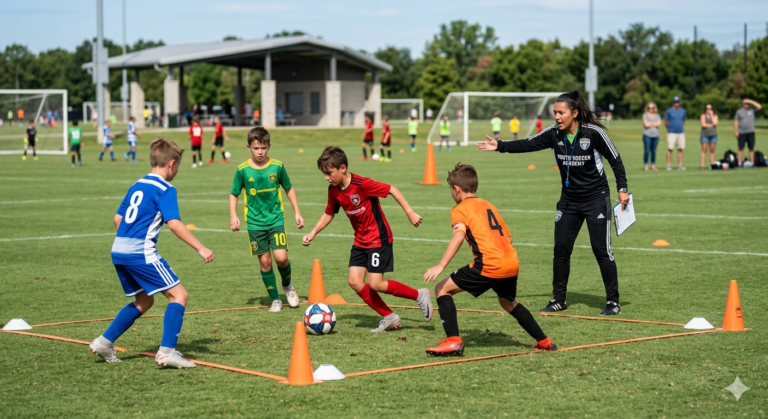
To keep kids engaged, we don’t just stand around and talk. Research suggests that coaches should aim for at least 70% “ball rolling” time. If the ball isn’t moving, the kids aren’t learning! For a standard 60-75 minute session, we recommend a station-based training model. This keeps things moving and caters to shorter attention spans. When kids are standing in long lines waiting for their turn to shoot, they lose focus, their heart rate drops, and they start to get distracted. By using stations, we ensure that every player is constantly active.

The ideal breakdown for a soccer fundamentals for kids session looks like this:
- 20% General Movement: Fun games that focus on how the body moves. This includes tag games, jumping, and crawling to build overall athleticism.
- 20% Coordination: Tasks that involve the ball and the body working together. Think of this as “ball mastery”—juggling, toe taps, and foundations.
- 20% Soccer Technique: Focused drills on dribbling, passing, or shooting. This is where we break down the mechanics of the “inside foot push” or the “laces drive.”
- 40% Small-Sided Games: 3v3 or 4v4 scrimmages where they can actually use their skills. This is the most important part because it allows for “free play” where the coach steps back and lets the game be the teacher.
Building Physical Literacy and Soccer Fundamentals for Kids
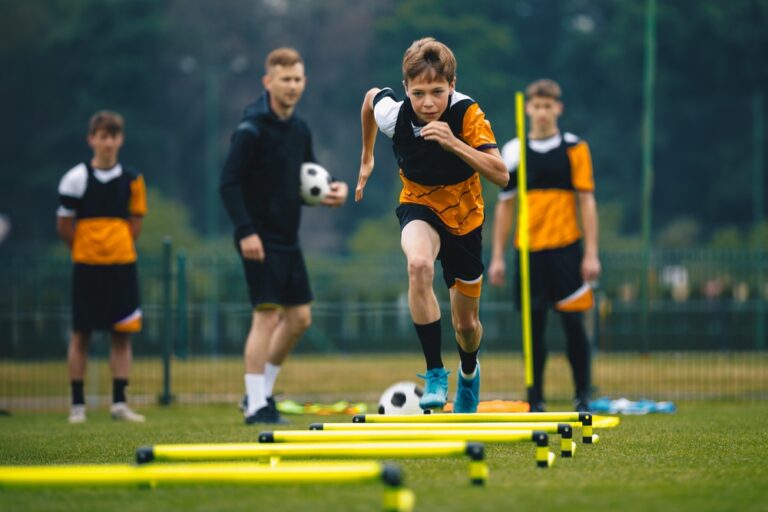
Before a player can master a “step-over” or a “rainbow flick,” they need to master their own body. General movement skills like agility, balance, coordination, and speed are the true fundamentals. If a player is clumsy without the ball, they will be clumsy with it. That’s why we incorporate “speed, agility, and quickness” (SAQ) drills into every session.
One of our favorite ways to build this is through “V-shape” movements. Have your players face a cone, then backpedal in a “V” shape away from the point at a 45-degree angle. Once they’ve reached a certain distance, have them explode forward. This teaches them how to open their hips and stay light on their toes—skills they’ll need when defending a fast winger at the Isle of Palms recreation fields or trying to beat a defender on Daniel Island. We focus on the “low center of gravity”—keeping the knees bent and the weight on the balls of the feet.
Mastering Core Techniques: Dribbling, Passing, and Shooting
When we talk about technique, we break it down into three phases: Preparation (getting your body in the right spot), Contact (where the foot meets the ball), and Follow-through (where your momentum goes after the kick). Mastering these phases is the key to ball mastery. If one phase is off, the whole skill breaks down. For example, if your preparation is slow, you won’t have time to make good contact. Check out more info on our training blog for deep dives into specific professional techniques and how to practice them at home in your backyard.
Ball Control: The Heart of Soccer Fundamentals for Kids
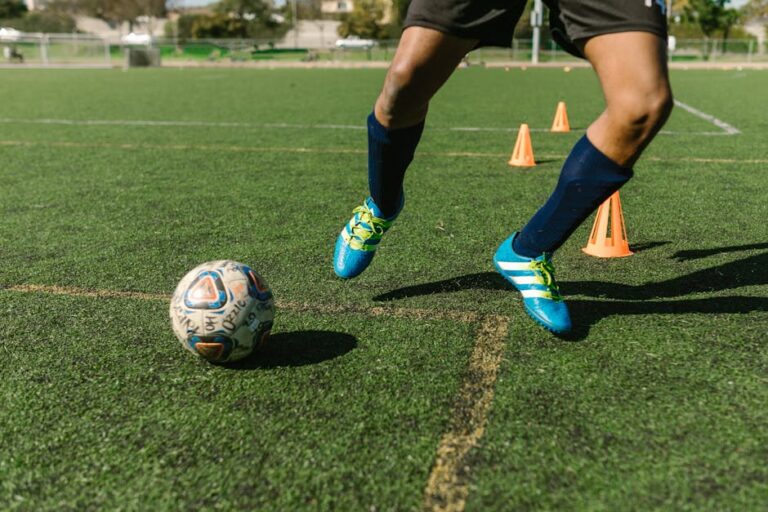
Ball control is the prerequisite for everything else. If you can’t control it, you can’t pass it or shoot it. We teach kids to use every part of their foot: the inside for accuracy, the outside for flair, the sole for stopping, and the laces for speed. In the modern game, being “two-footed” is a massive advantage, so we always practice with both the left and right feet.
A great drill to start with is the “3-Cone Dribble.” Set up three cones in a line and have the player dribble to the cone, touch it, and backpedal to the start. This builds “close control”—keeping the ball within one step of the body at all times. We tell our players to imagine the ball is on a string attached to their toe. The closer the ball stays, the harder it is for a defender to steal it.
Passing and Shooting for Success
For passing, we emphasize the “inside foot push.” The standing foot (the non-kicking foot) should point toward the target, acting like a compass. The kicking foot should be turned out at a 90-degree angle, striking the middle of the ball with the firm arch of the foot. We want the pass to be “crisp”—not too soft that it gets intercepted, and not too hard that a teammate can’t control it.
When it’s time to practice shooting, we tell our players that a shot is just a “pass to the back of the net.” Instead of just swinging wildly and hoping for the best, we focus on:
- Placement: Aiming for the corners where the keeper can’t reach. We often use “targets” like cones or water bottles in the corners of the goal.
- Contact: Striking the center of the ball with the laces (the “sweet spot”) for power. Keep the ankle locked and the toe pointed down.
- Follow-through: Stepping through the ball toward the goal to keep the shot low and powerful. If you lean back, the ball goes over the crossbar; if you lean forward and follow through, the ball stays on target.
Fun Drills and Small-Sided Games for Lowcountry Players
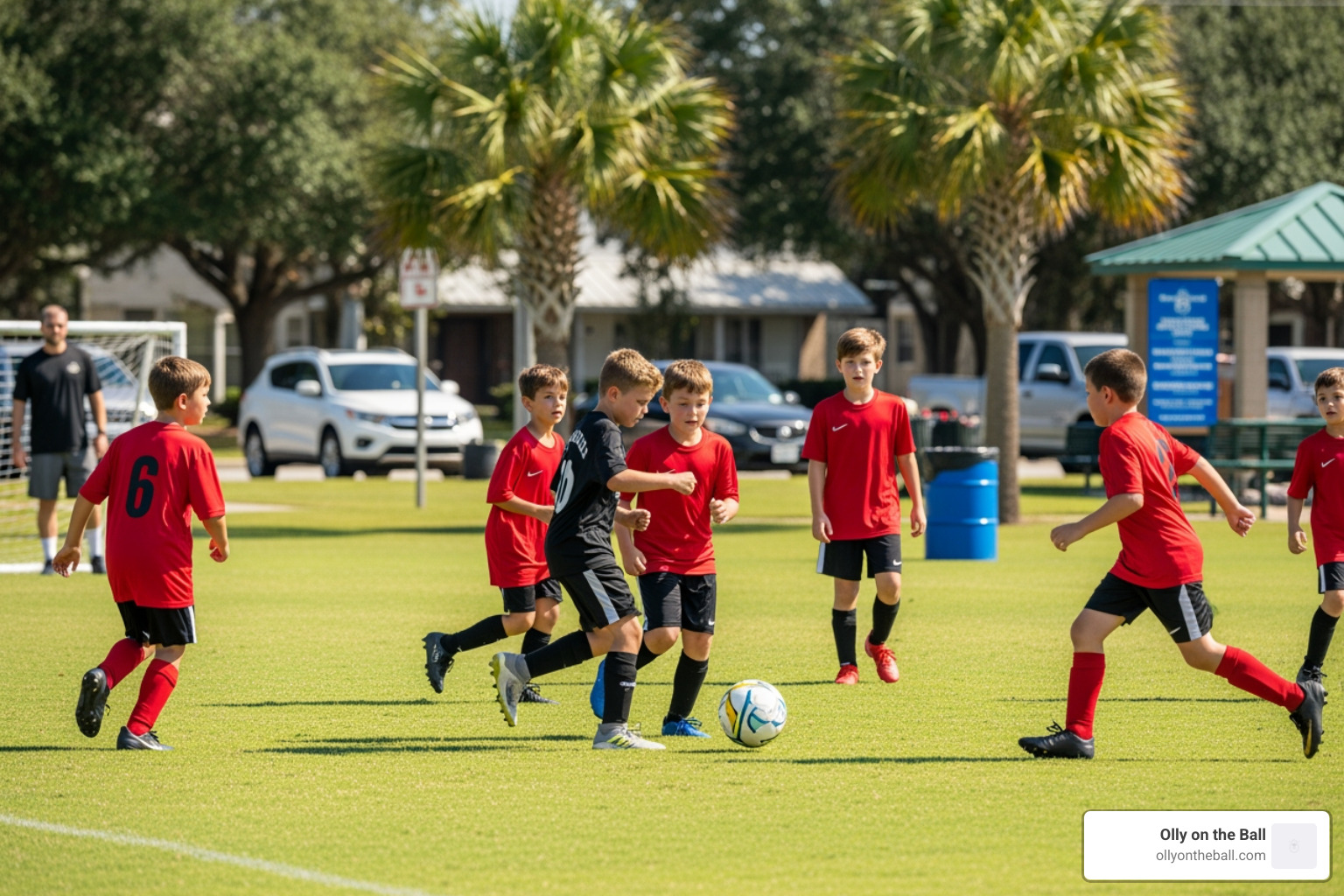
The best way to learn soccer fundamentals for kids is through play. In Charleston, we love using games that mimic match situations but feel like a playground. When kids are having fun, they don’t even realize they are working on their endurance and technical skills.
- Sharks and Minnows: Perfect for U6-U8 players. The “minnows” try to dribble across the “ocean” (the grid) without the “sharks” (defenders) kicking their ball out. This teaches shielding and dribbling under pressure. Pro Tip: Encourage the minnows to use “fakes” and changes of speed to get past the sharks.
- Red Light, Green Light: A classic that teaches kids to keep their heads up while dribbling and stop the ball instantly using the sole of their foot. This is vital for “spatial awareness”—knowing where the other players and the boundaries are.
- 3v3 Scrimmages: Small-sided games are the gold standard. In a 3v3, every kid gets more touches on the ball, more chances to score, and more decisions to make than in an 11v11 game. It forces them to be involved in both defending and attacking constantly.
For a creative twist at home, try this fun balloon game from The Inspired Treehouse. Using a balloon instead of a ball gives younger kids more “hang time” to coordinate their movements, which is a fantastic way to build confidence before moving to a heavier soccer ball. It’s especially great for rainy days when you can’t get out to the James Island or North Charleston fields.
The Coach’s Playbook: Gear and Engagement Tips
Being a great coach or a supportive soccer parent isn’t about knowing every rule in the FIFA handbook; it’s about enthusiasm! Kids feed off the energy of the adults around them. Use “Guided Discovery”—instead of telling a player exactly what to do, ask them questions that lead them to the answer. For example: “Where is the open space?” or “Which teammate can you see right now?” or “How can you get the ball to the other side of the field?” This builds “game intelligence” and helps them become independent thinkers on the pitch.
As for gear, you don’t need much to get started, but the right stuff helps ensure safety and comfort:
- The Ball: Size 3 for ages 8 and under, Size 4 for ages 8-12, and Size 5 for ages 13+. Using a ball that is too big can lead to poor technique and even injury, while a ball that is too small doesn’t provide the right feedback.
- Footwear: Proper cleats provide the traction needed for those quick cuts on our damp Lowcountry grass. Whether you’re playing at the Isle of Palms or Sullivan’s Island, the morning dew can make the grass slippery.
- Protection: Shinguards are a must for safety. Remember: socks go over the shinguards! This is a common mistake for beginners, but having the socks over the guards keeps them in place and prevents skin irritation.
At Olly on the Ball, we provide a positive, high-energy environment where we use these tools to build both skill and character. More info on our services is available for families in Summerville, Daniel Island, and beyond who want that extra edge in their development.
Frequently Asked Questions about Soccer Basics
What is the best age to start learning soccer fundamentals for kids?
While kids can start as early as 18 months with basic “toddler soccer” (focusing on balance, running, and simply having fun with a ball), the “FUNdamentals” stage really kicks into gear between ages 6 and 9. This is when they have the cognitive and physical coordination to start mastering specific ball skills like directed passing and controlled dribbling. However, it’s never too late to start! A 12-year-old can still make massive gains with the right coaching.
What equipment is essential for a beginner soccer player?
At a minimum, your child needs a size-appropriate soccer ball, a water bottle to stay hydrated in the South Carolina heat, and comfortable athletic clothes. If they are joining a league or a private session, cleats and shinguards are essential for safety and performance. We also recommend bringing a positive attitude and a willingness to try new things!
How can I make soccer practice more engaging for my child?
Keep it “game-like.” Avoid long lines where kids wait for their turn. Instead, use games like “Sharks and Minnows” or “Soccer Bowling” (knocking over cones with passes). The goal is maximum touches and maximum smiles! If they are practicing at home, keep the sessions short—15 to 20 minutes of high-quality play is better than an hour of bored repetition!
Conclusion
Mastering soccer fundamentals for kids is a journey, not a sprint. It takes patience, practice, and a lot of encouragement. Whether your child is inspired by the Charleston Battery and dreams of playing professionally, or just wants to run around with friends in James Island, the focus should always remain on building confidence and a genuine love for the game.
At Olly on the Ball, we offer a unique peer-to-peer mentoring experience. As a competitive player myself, I understand the modern game and can relate to your child in a way that traditional coaches might not. I’ve been in their shoes recently, and I know what it takes to overcome challenges on the field. We focus on the person, not just the player, ensuring that every child feels seen and supported.
Ready to see your child’s confidence soar on the pitch? More info about private training in Charleston is just a click away. Whether you are in Mount Pleasant, Daniel Island, or West Ashley, let’s get to work and have some fun!