

Youth soccer positions change depending on how many players are on the field. At U6 to U8 there aren’t really fixed positions at all. By U9 you’re usually playing 7v7 with a keeper, defenders, midfielders and a forward. By U13 it’s full 11v11 with all eleven roles. If you’ve been standing on a sideline in Mount Pleasant wondering what a “number 6” is and why your kid keeps getting moved, this guide is for you.
I’m Olly. I play for Surf and coach younger players around the Charleston area. I’ve played most of these positions myself, some of them badly, and I’ve had the “why am I at right back again” conversation more than once. Here’s the plain version.
The four position groups, in plain English
Every position on a soccer field belongs to one of four groups. Everything else is a variation.
- Goalkeeper. Stops shots. The only player who can use their hands, and only inside the penalty area. Also the loudest player on the field if they’re doing it right — the keeper can see the whole game and should be organising the defenders in front of them.
- Defenders. Stop the other team scoring, win the ball back, and start attacks. Centre backs stay central and deal with anything through the middle. Fullbacks play wide and cover the sidelines.
- Midfielders. The link between defence and attack. They cover the most ground of anyone on the field. Defensive mids sit in front of the back line and protect it. Central mids run box to box. Attacking mids create chances.
- Forwards. Play closest to the opponent’s goal and are mainly there to score. A striker plays central. Wingers play wide and attack from the sides.
What the numbers mean
You’ll hear coaches say “she’s a 6” or “he’s playing as a 10”. These numbers come from traditional shirt numbering and they describe a role, not a jersey. The common ones:
- 1 — goalkeeper
- 2 and 3 — right back and left back
- 4 and 5 — centre backs
- 6 — defensive midfielder, sitting in front of the defence
- 8 — central midfielder, box to box
- 10 — attacking midfielder, the creative one
- 7 and 11 — right winger and left winger
- 9 — centre forward, the main striker
At youth level nobody expects your player to know all of this. But when a coach says “get back into your six”, it just means drop in front of the back line and screen it.
Youth soccer positions by age and format
U6 to U8 — 4v4, no fixed positions
At this age most leagues play small-sided with no goalkeeper, and the honest truth is that positions barely exist. Everyone swarms the ball. That’s normal and it isn’t a problem to fix.
What matters at this stage is touches. A player who gets hundreds of touches a game learns more than one who holds a tactical shape perfectly. If your six-year-old is chasing the ball everywhere, they’re doing exactly the right thing.
U9 to U10 — 7v7, positions start to appear
Usually a 2-3-1: two defenders, three midfielders, one forward, plus a keeper. This is where kids first hear the words “stay wide” and “get goal side”.
Good coaches still rotate players through everything at this age. A player who has spent time in goal and time up front understands the game much better at 14 than one who was locked into right back at nine.
U11 to U12 — 9v9, roles get clearer
More structure, more defined jobs, bigger field. Players start to notice what they’re naturally good at. This is a reasonable age to start specialising a little — but “a little” is the key phrase. Rotation is still healthy.
U13 and up — 11v11, full positions
Now it’s the real thing. All eleven roles, full-size field, and coaches making genuine tactical decisions. By this point most players have a primary position and one or two they can cover.
How to tell which position suits your player
There’s no test for this, but there are patterns I see all the time:
- Loves being in the middle of everything, never stops running → midfield.
- Brave, reads danger early, doesn’t mind the physical side → centre back.
- Fast, likes running at people, wants the ball wide → winger or fullback.
- Calm in front of goal, good timing, doesn’t panic → striker.
- Vocal, brave, actually enjoys diving at feet → goalkeeper.
One thing worth saying to parents directly: don’t push a position too early. The best thing your player can do between 8 and 12 is play everywhere. Positional identity can wait. Ball skill can’t.
If your player is drawn to going in goal, the beginner’s guide to youth goalkeeper training covers what that path actually looks like. If they’re happiest at the back, these defensive drills are a good place to start.
What every position needs, regardless
Here’s the part that gets missed. Modern soccer asks every player to do everything. Defenders are expected to play out from the back. Forwards are expected to defend from the front. Keepers are expected to pass.
So whatever position your player ends up in, the same foundations show up:
- A first touch that puts the ball where they want it, under pressure
- Being comfortable on both feet
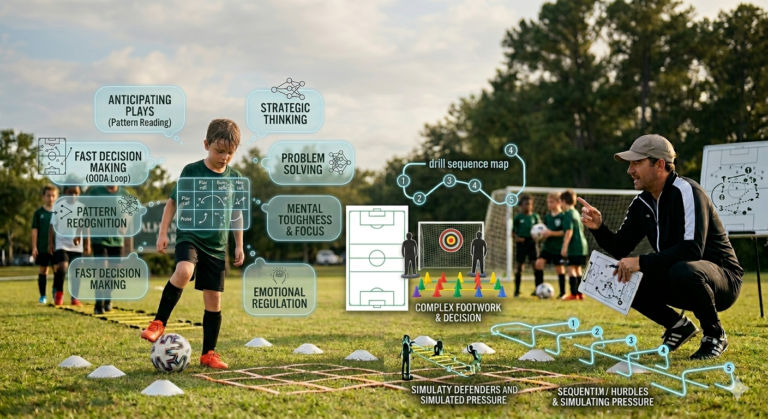
- Reading the game — knowing what they’ll do before the ball arrives
- Passing with the right weight to the right foot
That last one is really soccer IQ, and it’s the thing that separates players who look composed from players who look rushed. It’s trainable, and it’s worth training earlier than most families think.
When your kid is unhappy with their position
It happens to everybody. A few things that genuinely help:
- Let them be annoyed for a bit. Then ask what they think that position needs. It moves them from complaining to problem-solving.
- Encourage them to ask the coach directly — respectfully, and not straight after a game. “What would I need to work on to play midfield?” is a great question for a young player to learn to ask.
- Point out what they’re gaining. Time at fullback teaches defending, crossing and fitness. None of that is wasted if they end up a winger.
- Don’t call the coach for them. Tempting, but it costs your player more than it gains.
FAQ
What are the 11 soccer positions?
Goalkeeper, right back, left back, two centre backs, defensive midfielder, central midfielder, attacking midfielder, right winger, left winger and centre forward. Youth formats use fewer — 7v7 typically runs two defenders, three midfielders, one forward and a keeper.
Where do you put your strongest players in youth soccer?
Traditionally, centre back, central midfield and centre forward — the spine of the team, because those positions touch the ball most and influence the game most. But at younger ages, good coaches move their strongest players around so they develop rather than just dominate from one spot.
What position do you put your weakest player in soccer?
I’d push back on the question a bit. Hiding a player at fullback and hoping the ball doesn’t go there is how you end up with a player who never improves. Better to give them a role with clear, simple jobs — often a wide position — and coach them into it.
Which soccer position is hardest?
Goalkeeper, for most people, because the mistakes are so visible and so final. Tactically, central midfield is the hardest to play well — you’re under pressure from every angle and have to make decisions before you receive the ball.
Should young players specialise in one position?
Not before about U12. Players who rotate through positions early understand the game far better later on. Specialising at eight mostly limits what they learn.
What position gets the most touches?
Central midfield, comfortably. If your player wants to be on the ball constantly, that’s where to be — and it’s why so much of their training should be first touch and passing under pressure.
Getting sharper, whatever the position
Positions matter less than people think at young ages. Touches matter more. A player who is confident on the ball can play anywhere a coach asks them to — and that’s the whole point.
If your player wants extra reps outside club practice, that’s what I do. Get in touch and tell me their age and where they’ve been playing, and we’ll build sessions around what they actually need.
About Olly: Oliver “Olly” Sovenyhazy is a 16-year-old soccer player with Surf and a volunteer with the professional Charleston Battery. Through Olly on the Ball he coaches private, semi-private and small-group sessions for young players across Mount Pleasant and the Charleston area — building confidence through reps, and skills that hold up in real games.