
Soccer IQ training is the most important skill almost nobody trains on purpose. Technique gets practiced. Speed gets timed. Fitness gets tested. But the ability to read the game — to scan before you receive, to anticipate where the ball is about to be, to make the right decision under pressure in half a second — usually gets left to “they’ll pick it up.” The kids who pick it up fast become the kids coaches build teams around. The ones who don’t get stuck being technically good but never quite making it into the bigger conversations. Good news: soccer IQ is a trainable skill, and the work isn’t complicated — it just has to be done deliberately.
This guide covers what soccer IQ actually is, how it gets built in young players, what kind of training environment accelerates it, and the simple habits parents and coaches can reinforce that compound into real game intelligence over a season.
What soccer IQ actually means
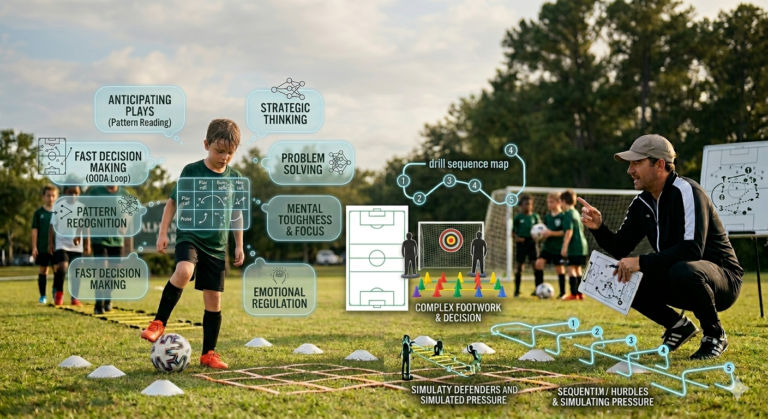
Soccer IQ is a loose label that covers a few different brain skills working together:
- Scanning — checking your shoulders before the ball arrives so you already know where pressure is and where space is.
- Anticipation — predicting where the next ball is going to land based on what teammates and opponents are doing.
- Decision-making — picking the right action (pass, dribble, shoot, hold) under time pressure with incomplete information.
- Spatial awareness — understanding shape, space, lanes, and triangles on the field as the game flows.
- Pattern recognition — seeing combinations (overlap, give-and-go, 3rd-man run) as they form and joining them at the right moment.
None of these are about ball skill in isolation. A player can have great technique and low soccer IQ — and they look slow, hesitant, late to the action. A player with average technique and high soccer IQ looks one step ahead of everyone. Coaches love these players. So do scouts.
Why scanning is the foundation skill
Of the five skills above, scanning is the one that unlocks the others. Players who can’t scan can’t anticipate (they don’t know where anyone is). They can’t decide cleanly (they’re solving the problem after the ball arrives, not before). They can’t see patterns (the field is a surprise every time the ball comes).
Research on professional players shows the best ones scan 8-12 times in the 10 seconds before they receive a pass. Average pros scan 4-6 times. Most youth players scan once, or zero. The gap between “elite scanner” and “doesn’t scan” is gigantic. The good news for young players: scanning is a habit, and habits get built with deliberate reps.
How to train scanning
Start with a simple constraint at training: before you can receive a pass, you have to call out a number on a coach or teammate’s hand behind you. This forces the head turn. Add complexity over time — call out a color, a body position, a teammate’s location. Within 4-6 weeks of consistent reps, the head check becomes automatic. Within a season, the player is scanning unprompted because they’ve internalized that the information is worth having.
Decision-making — the second-most-trainable IQ skill
Decision-making in soccer is a function of three things: speed, accuracy, and pattern library. The player has to decide quickly (speed), pick a good option (accuracy), and have a library of options to choose from (pattern library). All three are trainable:
- Speed: small-sided games with two-touch maximums. The constraint forces faster decisions. Over weeks, the player’s brain learns to start solving before the ball arrives instead of after.
- Accuracy: coach-led video review or post-rep questioning — “what were your options there? what was the best one? what made it best?” The brain learns to evaluate options, not just execute the first one.
- Pattern library: watching good soccer with intent. Not background TV — actual focused watching, with a parent or coach occasionally pausing to say “see what their #10 just did there?” An hour a week of intentional watching adds patterns to a young player’s library faster than another hour of training does.
The combination of constrained small-sided games + intentional film study is one of the highest-leverage development habits for ages 10-15.
Why most youth training underweights soccer IQ
Three reasons IQ training rarely gets the time it deserves in youth soccer environments:
- It’s hard to measure. A coach can post first-touch reps or sprint times. Reporting “her scanning frequency went up 40%” doesn’t fit on a poster.
- It looks like talking, not training. Parents watching a session see standing-around when the coach is asking “what did you see there?” Real IQ work doesn’t always look like work.
- It requires good coaching. Setting up the right small-sided game with the right constraints is harder than running cones. Most volunteer coaches don’t have the rep library.
The clubs and trainers that take IQ training seriously produce noticeably smarter players. It shows up in their game tape years before it shows up in their stats.
What parents can reinforce at home
Some of the highest-leverage IQ-building work happens off the field:
- Watch one MLS or Premier League game per week with intent. Pick one player on the field and watch only them for 10 minutes. Notice their head turns, their off-ball positioning, their decisions when they don’t get the ball.
- Post-game questions, not post-game critique. Instead of “why didn’t you pass?” try “what were you looking for when you got the ball there?” The first kills confidence. The second builds IQ.
- Talk about positioning, not just touches. Most car-ride conversations after a game cover ball-on-the-foot moments. Spend a few minutes on off-ball stuff — where the player was when their teammate had the ball. That awareness compounds.
- Find them an older player to watch. Whether it’s a club teammate two age groups up, a high school varsity game, or Olly’s own training sessions in Mount Pleasant — watching better players think the game is contagious in the best way.
How long does building soccer IQ take?
Scanning habit: 4-6 weeks of deliberate reps. Decision-making speed in 2-touch games: 6-10 weeks. Pattern recognition library: a full season of intentional film watching plus matches. Spatial awareness: 12-18 months of consistent small-sided game exposure. The good news — these layer. You don’t have to wait for each to finish before starting the next. The IQ work compounds, and by the second season of intentional training, the player looks different on the field even when their technical level hasn’t changed much.
FAQ — Soccer IQ training
Can you train soccer IQ or is it natural?
You can absolutely train it. Like every other “natural” skill in sports, what looks like talent is usually just earlier, more deliberate exposure. Players who grew up playing in mixed-age neighborhood games developed soccer IQ informally. Players who didn’t can still build it through deliberate small-sided games, scanning constraints, and intentional film watching.
What age should soccer IQ training start?
Light IQ work — small-sided games with simple constraints, casual film watching with a parent — can start at age 7-8. More structured work (scanning protocols, decision-speed drills, pattern recognition) lands well at ages 10+. Earlier than 10, kids’ brains are still building the basic spatial map of the game.
Is futsal good for building soccer IQ?
Yes — exceptionally. Futsal forces fast decisions in tight spaces with constant defender pressure. Every world-class technical player you’ve heard of grew up on futsal or street soccer. If you can get your player in a futsal league or pickup environment, do it. The IQ transfer to outdoor soccer is real.
How do I tell if my kid actually has high soccer IQ?
Watch what they do when they don’t have the ball. High-IQ players are constantly moving, scanning, looking for space, supporting teammates. Lower-IQ players stand still and wait for the ball to come to them. The off-ball minutes tell the story.
Can private training help with soccer IQ specifically, or is it only for technique?
It can — when the coach is intentional about it. The best private sessions mix technical reps with small-sided games and decision-prompt questions (“what was your second option there?”). If a private trainer only runs technical drills with no decision component, the IQ side won’t move.
The game is faster now. Your training should be too.
Soccer IQ is what separates the players who execute technique in a vacuum from the players who execute it in a real game. The skill is trainable, the work isn’t complicated, and the compounding is real — the kids who build the scanning habit at 10 are reading the game at 14 in a way that genuinely changes what positions, clubs, and opportunities are open to them.
If you want to talk through how to build soccer IQ into a young player’s training plan — whether through private sessions or off-field habits — head to the contact page. For more on the brain side of soccer, see why your child needs a soccer brain and how to kickstart your child’s advanced soccer skills. For the speed-of-play side that pairs with high IQ, read speed of play — the #1 skill that separates good from great players.