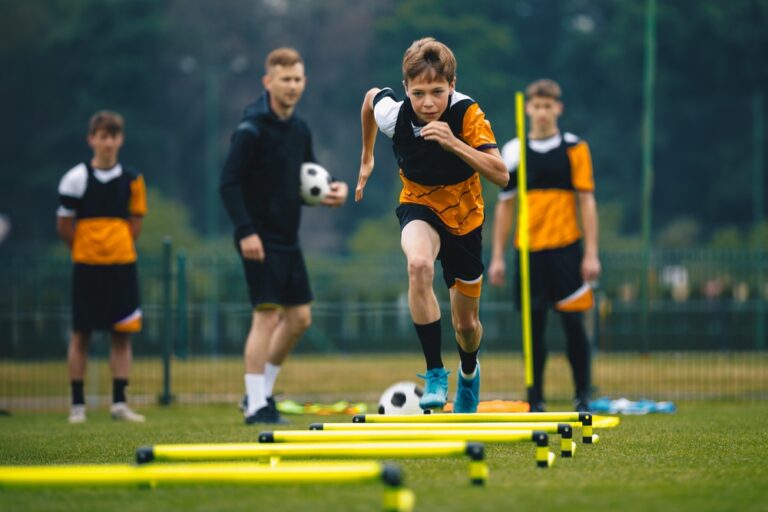


Private soccer training is worth it when a player wants it, when they’re already getting regular team practice, and when the coach is actually teaching rather than just running drills. It isn’t worth it when a parent wants it more than the kid does, or when it’s being used to fix something a team practice would fix for free. I coach these sessions for a living, so take my answer with that in mind — but I’d rather tell you the honest version than the sales version.
I’m Olly. I play for Surf, volunteer with the Charleston Battery, and train younger players around Mount Pleasant. Here’s how I’d think about it if it were my money.
The case for private training
Touches. This is the real one. At a club practice with eighteen players and two coaches, a young player might get a few hundred touches in ninety minutes. In an hour of one-on-one training, they’ll get well over a thousand, and every one of them can be corrected. That gap compounds fast.
Correction in real time. A team coach can’t stop the session to fix one player’s standing foot. In a private session that’s the entire job. Small technical faults that would take two seasons to self-correct get fixed in a few weeks.
It’s built around your player. If a player is brilliant on the ball but hides when the game gets physical, we work on that. If they’re brave but their first touch bounces away from them, we work on that instead. Team practice has to serve eighteen players at once.
Confidence. This is the one parents mention most afterwards, and it surprises them. A player who has done something a thousand times in training stops hesitating in games. Confidence in young players almost always traces back to preparation, not personality.
The case against — and when I say no
I turn down families sometimes. Here’s when.
When the kid doesn’t want it. This is the big one. If a player has been signed up because a parent wants them to be better, the sessions don’t work. They show up flat, they do the reps without meaning them, and nothing sticks. Soccer has to stay something they enjoy, or none of this matters.
When they’re already overloaded. Three club practices, a game, school, and now private training on top? That’s a fast route to burnout and injury. Sometimes the right advice is fewer sessions, not more.
When the problem isn’t technical. If a player is struggling because they’re playing up an age group, or because they don’t like their team, private training won’t fix that. It’ll just be an expensive way to avoid the real conversation.
When they’re very young and just need to play. Under about seven, unstructured play in the yard beats formal training almost every time. Let them mess about with a ball.
What it costs, and how to think about the money
Around Charleston, private youth soccer training generally runs somewhere in the $40 to $80 per hour range depending on the coach’s background and whether travel is involved. My private sessions are $45 an hour, and semi-private — two to four players sharing a session — is $30 per player. You can see the full picture in the breakdown of private soccer lesson costs.
The thing I’d say about budget: consistency beats intensity. Eight sessions spread over two months does far more than four sessions crammed into two weeks before tryouts. If the weekly number is a stretch, semi-private every week is a better investment than private once a month. Real development comes from repetition over time, not from a burst.
How to tell if it’s actually working
Don’t measure it in goals. Goals are noisy — a player can have a brilliant month and not score. Look for these instead, roughly on this timeline:
- Weeks 2–4: They’re more willing to take the ball in tight spaces instead of passing it first time to get rid of it.
- Weeks 4–8: Their first touch settles. Fewer balls bouncing off them. They look less rushed.
- Weeks 8–12: They try things in games they used to only try in training. This is the real milestone.
- Throughout: They want to go. If they’re asking when the next session is, it’s working.
If none of that is happening after two or three months, something’s wrong — the coach, the fit, or the timing. A good coach will tell you that themselves.
Questions worth asking any coach before you book
Whether it’s me or anyone else in the Charleston area:
- What will you actually work on with my player in the first month?
- How will I know it’s working?
- Do you talk to me after sessions, or just at the end of a block?
- What happens if my player isn’t enjoying it?
- Are you insured, and have you had a background check?
A coach who can’t answer the first two clearly is running drills, not developing a player. There’s more on this in how to choose a private soccer coach in Charleston, including the questions that matter most for younger players.
Is private soccer training worth it for a 10-year-old specifically?
This comes up more than any other age, so let me answer it directly.
Ten is a genuinely good age for it. Players at ten are old enough to concentrate for an hour and take on technical correction, but young enough that habits aren’t set. The window between about nine and thirteen is when technique embeds most easily — the coaching world calls it the skill-hungry years, and it’s real.
The caveat: at ten, the goal should be technique and enjoyment, not tactics and results. If a coach is talking to a ten-year-old about pressing triggers and defensive shape, they’ve got the priorities backwards. Ball mastery, first touch, both feet, confidence in 1v1s. That’s the list.
The alternative nobody mentions
If private training isn’t right for your family right now, the cheapest effective option is a ball in the yard and fifteen minutes a day. I’m serious. Most of what I coach in the first month is stuff a motivated player can drill alone — sole rolls, toe taps, wall passes, both feet.
Private training accelerates that and corrects what a player can’t see themselves. But it doesn’t replace it. Any coach who tells you their sessions are the only path is selling you something.
FAQ
Is private soccer training worth it for a 10-year-old?
Usually yes, if the player wants it. Nine to thirteen is the age range where technique embeds most easily, and one focused hour a week alongside team practice makes a visible difference within a couple of months. The session should be about technique and confidence at that age, not tactics.
How much does private soccer training cost in Charleston SC?
Roughly $40 to $80 an hour depending on the coach. My private sessions are $45 an hour and semi-private is $30 per player. Ask whether travel to your field is included, because that varies.
How often should a young player do private training?
Once a week is the sweet spot for most players who are also doing club practice. Twice a week suits a player with a specific goal and the energy for it. More than that and you’re risking burnout without much extra gain.
Will private training get my child on a better team?
It improves their chances, but no honest coach guarantees a roster spot — team selection involves size, age, position need and politics that no trainer controls. What training does is make sure your player is judged on their best. What coaches actually look for at tryouts covers the rest.
Is group training better value than private?
Per dollar, often yes — especially semi-private, where you keep most of the individual attention and add a competitive edge. Private is more efficient when there’s one specific technical problem to solve.
At what age is private soccer training too early?
Under about seven, I’d say free play beats formal sessions. The exception is a young player who genuinely asks for it and enjoys the structure — but that should come from them.
The honest summary
Private training is worth it when the player wants it, when it’s consistent, and when the coach is teaching rather than babysitting a ball. It’s a poor investment when it’s a parent’s idea, when it’s crammed in before a deadline, or when it’s replacing something free that would work just as well.
If you want to talk it through before committing to anything, just get in touch. Tell me your player’s age and what you’re hoping changes, and I’ll give you a straight answer — including if I think the answer is no.
About Olly: Oliver “Olly” Sovenyhazy is a 16-year-old soccer player with Surf and a volunteer with the professional Charleston Battery. Through Olly on the Ball he coaches private, semi-private and small-group sessions for young players across Mount Pleasant and the Charleston area — building confidence through reps, and skills that hold up in real games.