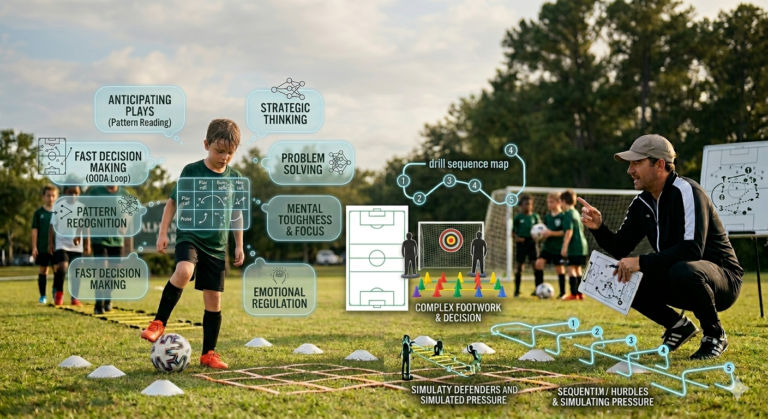


The fastest way to get more playing time in soccer is to become the player a coach trusts in the situations they’re worried about. That usually means work rate, reliability, and being useful without the ball — not scoring more goals. I’ve sat on a bench. I’ve also been the one brought on early because the coach knew what he’d get. The difference between those two versions of me had very little to do with talent.
I’m Olly, I play for Surf, and I coach younger players around Mount Pleasant. This one’s written for the player, not the parent — though parents, there’s a section for you at the end.
First, understand how the decision actually gets made
Coaches aren’t picking their favourite players. They’re picking the players they trust to do a specific job for the next twenty minutes. That’s a different question, and it’s good news, because trust is something you can build on purpose.
When a coach looks at the bench thinking about a substitution, they’re asking: who keeps their shape? Who’ll track back? Who won’t lose the ball in a dangerous area? Who’s warmed up and ready right now?
Notice that none of those are “who’s the most skilful”. Skill gets you into the squad. Reliability gets you onto the field.
How to get more playing time in soccer: six things that move the needle
1. Be the hardest worker at training, every session
Not occasionally. Every session. Coaches are watching training far more closely than players think, and they’re building a picture over weeks. First to arrive, first in every sprint, still going in the last ten minutes when everyone else has slowed down.
This is the single most controllable thing on the list and it’s the one most players skip.
2. Get good at the unglamorous stuff
Every team has three or four players who can do a stepover. Far fewer can defend properly, track a runner, or take a throw-in quickly and accurately.
Being genuinely good at the things nobody practises makes you useful in a way that’s hard to replace. Defending well is the biggest one — a forward who defends from the front gets picked ahead of a forward who doesn’t, almost every time.
3. Learn a second position
If you’re one of four central midfielders, you’re competing with three people for one or two spots. Learn to cover fullback and suddenly you’re in the conversation for four positions instead of two.
I know it doesn’t feel like the dream. But minutes at right back are still minutes, and players who can cover multiple roles get on the field far more often. Understanding the game broadly is what makes this possible.
4. Talk
Almost nobody at youth level talks on a soccer field, so the players who do stand out immediately. Not shouting — communicating. “Man on.” “Time.” “Switch it.” “I’m here.”
A player who organises the people around them makes the whole team better, and coaches notice within one session.
5. Be ready when your name gets called
This sounds obvious and it gets missed constantly. If you’re on the bench: warm up properly before you’re asked, stay warm, watch the game rather than watching your phone or chatting.
When a coach turns around needing someone on in thirty seconds, they pick the player who’s already moving.
6. Handle not playing well
This is the one that separates players more than anything else. Sulking on the bench, body language dropping, throwing your bib down — coaches see all of it, and it makes you a risk.
Staying engaged when you’re not playing is genuinely hard, and it’s also the clearest signal you can send about what kind of teammate you are.
Have the conversation — properly
At some point you should ask your coach directly. Do it well and it helps enormously. Do it badly and it makes things worse.
How to do it:
- Ask at training, not straight after a game when emotions are high.
- Ask for a couple of minutes rather than ambushing them.
- Use this question: “What do I need to work on to get more minutes?”
- Then actually listen. Don’t argue, don’t explain. Just take it.
- Work on exactly what they said, and let them see you doing it.
That last step is where it pays off. A coach who tells a player to improve their first touch and then watches them stay after training for three weeks doing exactly that will find them minutes. It’s not really about the touch at that point.
What to do with the extra time
If you’re not playing much, you’ve got something the starters don’t: time. Use it.
- Fifteen minutes a day on the ball. Sole rolls, toe taps, wall passes, both feet. Backyard first-touch work costs nothing and compounds fast.
- Get sharp on your weak foot. One of the quickest ways to become more useful to a coach.
- Watch your position. Pick a professional who plays where you play and watch what they do without the ball. That’s where the learning is.
- Get fitter. Being able to press for the full game is a genuine selection factor at every level.
When it isn’t your fault
Honest section. Sometimes you’re doing everything right and still not playing.
Sometimes a coach has a favourite. Sometimes a player’s parent is on the board. Sometimes you’re a September birthday in a squad of Januarys and you’re physically a year behind — that’s real and it evens out.
If you’ve worked hard, asked the question, done what was asked, and given it a full season — then it might genuinely be the wrong team, and moving is a reasonable choice, not a failure. Knowing what coaches look for at tryouts helps a lot when that time comes.
Just be honest with yourself about which situation you’re actually in. Most players who think it’s politics haven’t yet done the six things above for a full season.
For parents
Three things, briefly:
- Don’t email the coach about playing time. It rarely helps and it takes the situation out of your player’s hands. Let them ask.
- Don’t compare them to teammates out loud. It sticks, and it doesn’t motivate.
- Do help them channel it. “That’s frustrating — what do you want to work on?” turns disappointment into a plan.
FAQ
How do I get more playing time in soccer?
Be the hardest worker at training, get good at defending and the unglamorous work, learn a second position, communicate on the field, stay ready on the bench, and ask your coach directly what they need from you. Reliability gets more minutes than flair does.
Should I ask my coach why I’m not playing?
Yes — but ask “what do I need to work on to get more minutes?” rather than “why am I not playing?”. The first is a question a coach can answer helpfully. Ask at training, not straight after a game.
How long should I give it before considering a different team?
A full season, provided you’ve genuinely worked and had the conversation. Coaches’ opinions shift more slowly than players expect, and mid-season moves rarely solve anything.
Does private training help you get more playing time?
It helps if it targets what your coach has actually asked for. Extra touches build the technical confidence that shows up in games — but the work rate and attitude side is free, and matters just as much.
Why do coaches play the same players every week?
Usually trust rather than favouritism. Coaches pick players whose performance they can predict. Becoming predictable in a good way is the whole task.
Is it worth playing a position I don’t like to get minutes?
Almost always, at youth level. Minutes are development, and versatile players get picked more often. You can move back to your preferred position later with more experience than the players who refused.
Earn it
Playing time isn’t given out fairly, but it is earned more often than young players believe. The work rate part is completely in your control, starting at the next session.
If you want help getting sharper on the ball so the technical side isn’t what’s holding you back, get in touch. We’ll build sessions around what your coach has told you to fix.
About Olly: Oliver “Olly” Sovenyhazy is a 16-year-old soccer player with Surf and a volunteer with the professional Charleston Battery. Through Olly on the Ball he coaches private, semi-private and small-group sessions for young players across Mount Pleasant and the Charleston area — building confidence through reps, and skills that hold up in real games.