
Why Defensive Soccer Skills Youth Players Learn Early Make All the Difference
Defensive soccer skills youth players develop early are the foundation of every great team — and they’re more exciting to learn than most kids think.
Here’s a quick look at the core defensive skills every young player should know:
| Skill | What It Means |
|---|---|
| Pressure | The closest defender closes down the ball quickly |
| Cover | A second defender supports in case the first is beaten |
| Balance | A third defender protects space and stays organized |
| Jockeying | Mirroring the attacker to slow them down without diving in |
| Goal-side positioning | Always staying between the attacker and your own goal |
| Communication | Using your voice — “Man on!”, “Step up!”, “Switch!” |
As the saying goes, “Offense wins games, but defense wins championships.” And that’s especially true at the youth level, where one solid defensive unit can outperform a team full of flashy attackers.
Here in Charleston and Mount Pleasant, youth soccer is growing fast. Kids are playing harder, getting smarter, and clubs are raising the bar every season. Whether your child plays for a local rec team or is chasing a spot on a competitive club squad, learning to defend properly — not just chase the ball — is what separates good players from great ones.
The problem? Most crowded club practices don’t have time to break down individual defending. Kids pick up bad habits. They dive in too early. They chase the ball in packs. And their confidence takes a hit when attackers blow past them.
That’s exactly what this guide is here to fix.
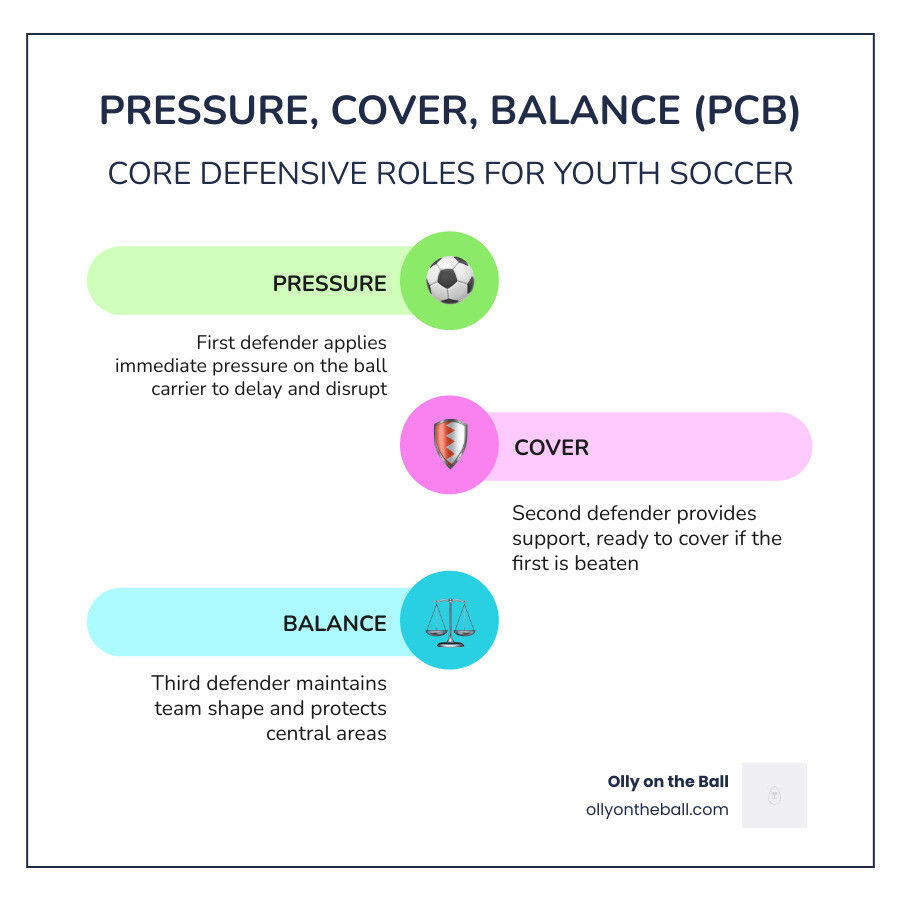
The Core Principles of Defensive Soccer Skills Youth
When we talk about defensive soccer skills youth players need to master, we aren’t just talking about big kicks or hard tackles. True defending is about “controlled aggression.” It’s a mix of smart positioning, patience, and working as a unit.
In the Lowcountry, we see a lot of “beehive soccer” at the U6 and U8 levels—where everyone just chases the ball. Breaking that habit early is the first step toward becoming an elite player. To do that, we teach the An introduction to defending through three specific roles.
Individual Roles: Delay, Cover, and Balance
Defending is like a game of chess. If one piece moves, the others have to react to keep the “King” (the goal) safe. We break this down into three roles:
- First Defender (Delay): Your job isn’t necessarily to steal the ball right away. It’s to stop the attacker from moving forward. You want to “delay” them until your teammates can get back to help. Think of it like a speed bump—you’re slowing them down so they can’t just sprint toward the goal.
- Second Defender (Cover): If you’re the second defender, you aren’t watching the ball; you’re watching your teammate. You stand a few yards behind and to the side of the first defender. If the attacker dribbles past the first defender, you’re right there to step in.
- Third Defender (Balance): This player looks at the whole field. They make sure no one is sneaking in on the “weak side” (the side away from the ball). They provide balance to the team shape so the defense doesn’t get pulled too far in one direction.
Watching the Charleston Battery play at Patriots Point is a great way to see this in action. Notice how their backline moves together like they’re connected by an invisible string. That’s the “Lowcountry hustle” we want to see in our youth players!
Winning the 1v1: Mastering Youth Defensive Soccer Skills
The 1v1 is the ultimate test of a defender. Most young players make the mistake of sprinting full speed at an attacker. A smart attacker will just touch the ball to the side and fly right past you.
To win a 1v1, you need patience. Instead of “diving in” (trying to kick the ball while the attacker still has control), you should:
- Read the hips: Don’t look at the ball or the attacker’s fancy footwork. Watch their hips—they can’t go anywhere without them!
- Force them wide: Use your body angle to guide the attacker toward the sideline. The sideline is like an extra defender; once they’re stuck there, they have nowhere to go.
- Time the tackle: Wait for the moment the attacker takes a heavy touch or gets the ball stuck under their feet. That’s your green light to win possession.
Want to see how we practice this? Check out More info about Olly’s training to see how we break down these 1v1 battles in our private sessions.

Mastering the 1v1: Stance, Jockeying, and Timing
If you want to be a lockdown defender, your “ready stance” is everything. You can’t defend standing flat-footed.
The Perfect Defensive Stance
- Staggered Stance: One foot forward, one foot back. This allows you to turn quickly in either direction.
- On the Balls of Your Feet: Keep your heels slightly off the ground. This makes you “springy” and ready to react.
- Low Center of Gravity: Bend your knees! Being low makes you harder to knock off balance and allows you to explode into a sprint.
Jockeying Technique
Jockeying is the art of mirroring the attacker. Imagine you are a mirror—wherever they go, you go. You want to maintain a distance of about three steps. This gives you enough room to react if they try to sprint, but keeps you close enough to block a shot or pass.
We often use the “pop and release” technique. This is great for when an attacker turns their back to you. You “pop” in to apply pressure, then “release” slightly if they try to turn, keeping your goal-side positioning intact. This kind of Intelligent defending is what we focus on at Olly on the Ball.
The Goalkeeper’s Role in Youth Defensive Soccer Skills
The goalkeeper is the “General” of the defense. Because they can see the whole field, they have the best view of the game.
A great youth keeper doesn’t just stop shots; they prevent them by talking. We teach our keepers to use loud, clear commands like:
- “Away!” (Clear the ball)
- “Step up!” (Move the defensive line forward)
- “Keeper!” (I’m coming to get the ball)
Goalkeepers are also the first line of attack. After a save, their distribution—whether a throw or a punt—starts the counter-attack. For parents keeping track of games, checking Referee Schedules can help you stay on top of the local Charleston soccer circuit so your player never misses a chance to lead from the back.
Safe Tackling and Intercepting for Kids
Safety is our number one priority. We want kids to be tough, but we also want them to stay on the field!
- The Block Tackle: This is the safest and most common tackle. You use the inside of your foot (like a pass) to “block” the ball as the attacker tries to dribble through you. Keep your ankle locked and your body weight forward.
- The Poke Tackle: If an attacker gets a step on you, a quick “poke” with your toe can knock the ball away. It’s not about winning the ball cleanly; it’s about disrupting their rhythm.
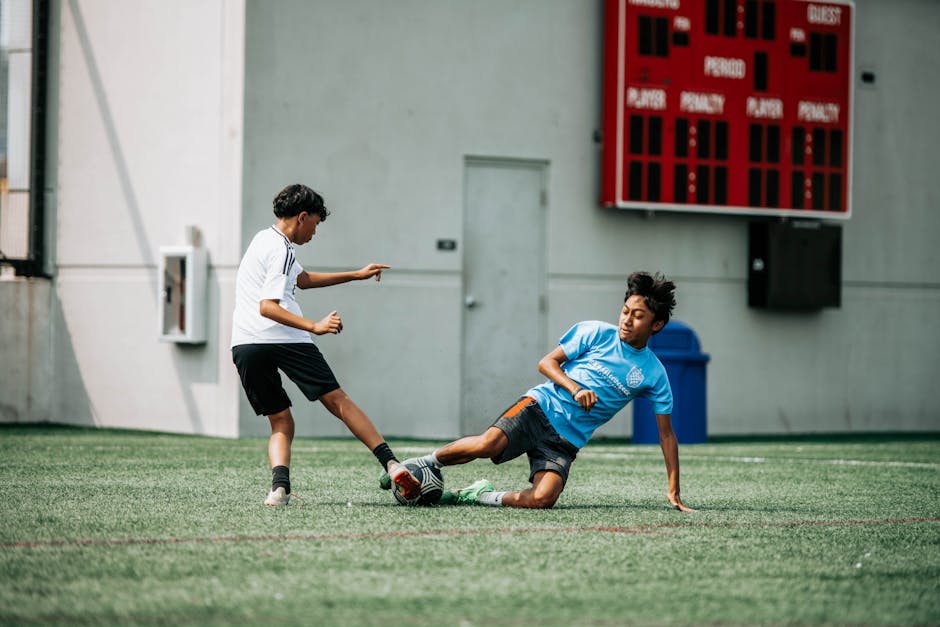
- The Slide Tackle: We usually save this for older, more experienced players (U12+). It’s a last resort. The key is to watch the ball, not the player, and always lead with the foot that is not tucked under you.
Intercepting is even better than tackling. It means you read the passer’s eyes and body language, stepped in front of the ball, and took it before it even reached the attacker. It’s cleaner, safer, and keeps the game moving!
Building a Team Wall: Shape, Compactness, and Communication
Individual skills are great, but defending is a team sport. A “Human Wall” is built when the whole team stays compact. This means minimizing the space between players so the other team can’t play “through balls” between your defenders.
Zonal vs. Man-to-Man Marking
In youth soccer, we usually see two types of marking. Here’s a quick comparison:
| Feature | Zonal Marking | Man-to-Man Marking |
|---|---|---|
| Focus | Defending a specific area of the pitch | Defending a specific opponent |
| Best For | Maintaining team shape and clogging lanes | Shutting down a “star player” |
| Pros | Less tiring; keeps the middle of the field crowded | Very clear roles; easy for kids to understand |
| Cons | Can leave gaps if players don’t communicate | One fast attacker can pull the whole defense out of shape |
Communication Cues
You can’t have a strong defense if everyone is quiet. We encourage our players in Mount Pleasant and Daniel Island to be the loudest ones on the pitch.
- “Man on!”: Tells your teammate an attacker is closing in.
- “Step up!”: Commands the defense to move forward to catch the other team offsides.
- “Switch!”: Tells a teammate to swap who they are marking.
Staying Goal-Side and Forcing the Play Wide
The “Golden Rule” of defending is staying goal-side. This means your body should always be between the ball and your own goal. If the attacker is closer to the goal than you are, you’re in trouble!
In the final third (the area closest to your goal), your job is to guide the attacker toward the corner flags. By forcing them wide, you take away their angle to shoot. It’s much harder to score from the sideline than it is from the middle of the box!
Transitioning from Attack to Defense: The 5-Second Rule
The most dangerous time in a soccer game is right after you lose the ball. Your team is spread out, and the other team is ready to counter-attack.
We teach the “5-Second Rule”: As soon as we lose the ball, we have 5 seconds of “counter-pressing.” We sprint to the ball to try and win it back immediately while the other team is still disorganized. If we don’t win it in 5 seconds, we drop back into our defensive shape.
This requires a “mental switch.” You can’t pout because you lost the ball; you have to put your head down and perform a recovery run. A recovery run isn’t just a slow jog back—it’s a sprint at an angle to get back into a goal-side position.
Top Defensive Drills for Charleston Youth Players
Practice makes perfect, but only if the practice is fun! At Olly on the Ball, we use drills that simulate real game moments. You can find more ideas on More about Olly’s blog.
1v1 Defending Diamond
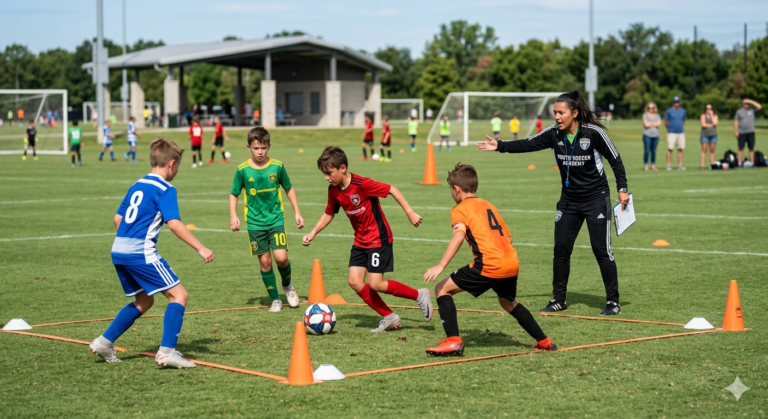
Set up four cones in a diamond shape. The defender starts at the bottom cone and passes the ball to the attacker at the top cone. The defender then sprints out to “close the gap,” slows down as they get close, and tries to win the ball before the attacker can dribble through the side cones.
2v2 Sideline Trap
This drill teaches teammates how to work together. The goal is for the first defender to force the attacker toward the sideline while the second defender “covers” the middle. When the attacker gets stuck against the line, both defenders close in to “trap” the ball.
The Numbers Game
The coach calls out a number (e.g., “Two!”). Two players from each side sprint onto the field. This creates a 2v2 scenario where players have to communicate instantly to decide who is “Pressure” and who is “Cover.”
Funnel Games and Shadow Defending for U8-U12
For our younger players in Summerville and James Island, we focus on non-contact drills to build confidence.
Shadow Defending is like a game of tag. One player is the “leader” and the other is the “shadow.” The shadow has to stay exactly three steps away from the leader, mirroring every cut and turn they make. This builds the footwork needed for jockeying without the fear of getting hit by the ball.
The Funnel Game involves setting up a wide area that narrows down into a small “funnel” (the goal). The defenders have to work together to keep the attackers from entering the funnel. It teaches space reduction and how to “clog the lanes.”
To learn more about how I grew up playing these games right here in the Lowcountry, check out the About Olly Sovenyhazy page.
Frequently Asked Questions about Youth Defending
How do I teach my child to tackle safely?
Start with the block tackle. Have your child stand over the ball and practice locking their ankle while you (the parent) provide a little resistance with your foot. Emphasize that they should never “lunge” or jump at the ball. Patience and timing are more important than force!
What is the “Golden Rule” of defending?
Always stay goal-side. If you can see the back of the attacker’s jersey, you aren’t goal-side. Keep your body between the ball and the net at all times. Also, never let an attacker beat you on the “inside” (toward the middle of the field). Always force them wide.
How can I make defending fun for my players?
Reward the “dirty work!” In practice, give points for a great interception or a solid block tackle, not just for goals. Celebrate “clean sheets” (games where the other team doesn’t score) like they are championship wins. When kids see that defending is valued, they’ll fall in love with the role.
Conclusion
Mastering defensive soccer skills youth players can use to protect their goal is one of the most rewarding parts of the game. There is nothing quite like the feeling of a perfectly timed tackle or a goal-line clearance that saves the match.
At Olly on the Ball, we believe that every player—whether they want to be a striker or a center-back—needs to know how to defend. Our peer-led coaching style means I’m right there on the pitch with your child, showing them exactly how to shuffle their feet, when to step up, and how to lead with confidence.
We serve families all over the Lowcountry, from the fields at Isle of Palms to the parks in North Charleston. If you’re ready to see your child build the “Human Wall” and play with more hustle and heart, let’s get to work.
Contact Olly to Get Started today and book a private or small-group session in Charleston or Mount Pleasant!