
Why Small Sided Soccer Games are the Secret to Skill Development
#
Small sided soccer games are training games played between two teams with fewer players than a standard 11v11 match — typically formats like 3v3, 4v4, or 5v5 on a smaller field.
Here’s a quick overview of the most popular formats:
| Format | Best For | Field Size |
|---|---|---|
| 3v3 | Ages 6-8, max touches | 15×20 yards |
| 4v4 | Ages 8-10, skills + tactics | 25×35 yards |
| 5v5 | Ages 10-13, complexity + teamwork | 25×35 yards |
| 6v6+ | High school, advanced play | 35×50 yards |
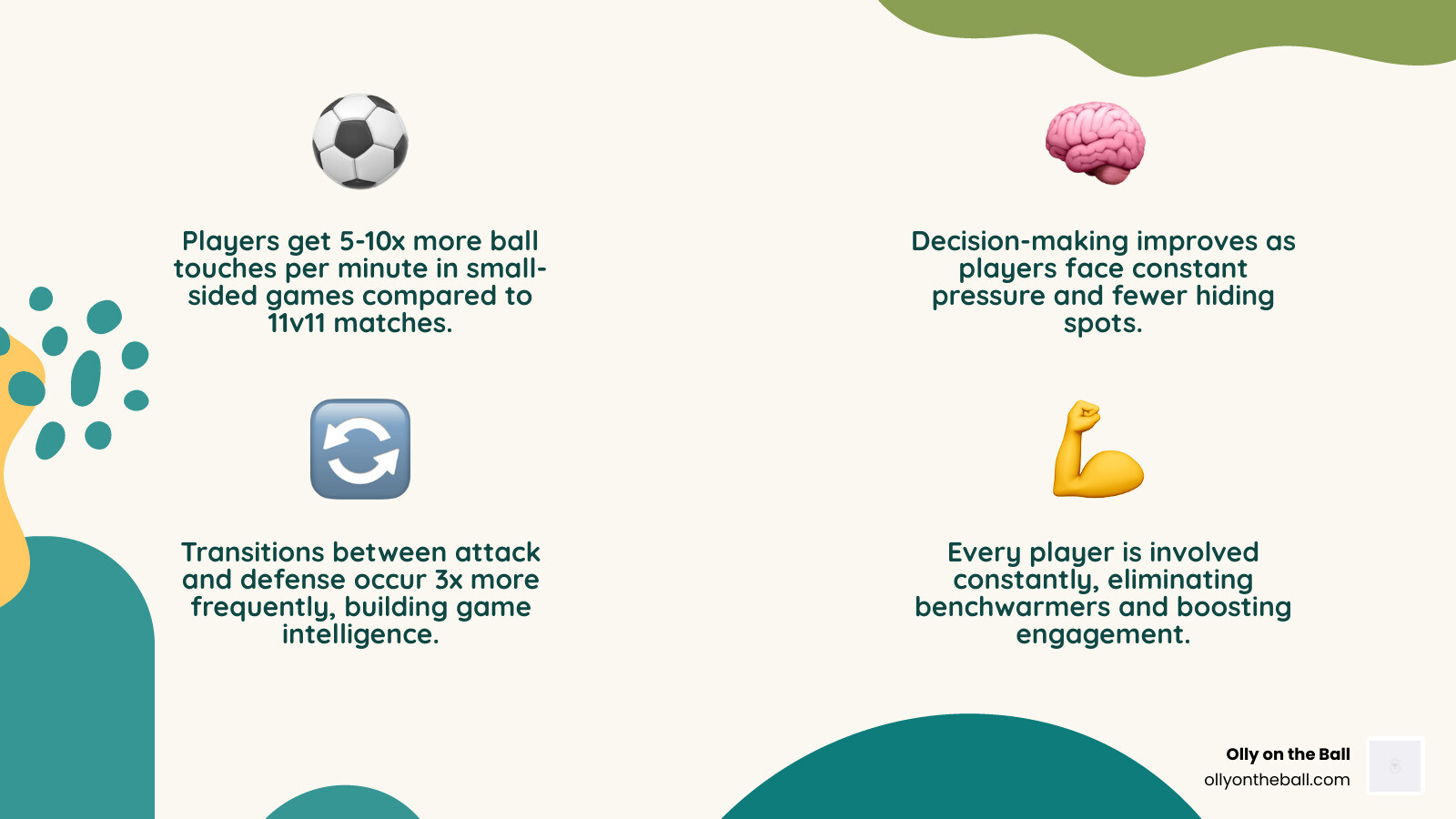
Why they work:
- Every player touches the ball way more than in a full-sided game
- Players are forced to make real decisions under real pressure
- Transitions happen constantly — attack, defend, attack again
- No hiding. Everyone is involved, every minute
Whether you’re a parent in Mount Pleasant looking for a way to help your kid level up, or a young player who wants more game-like reps, small-sided games are the single best training tool available. Period.
Here in Charleston, most club practices are crowded. Your child might touch the ball a handful of times in a 90-minute session. Small-sided games flip that completely — every rep counts, every touch matters.
This guide walks you through exactly how to set them up, which formats to use, and what to coach inside them.
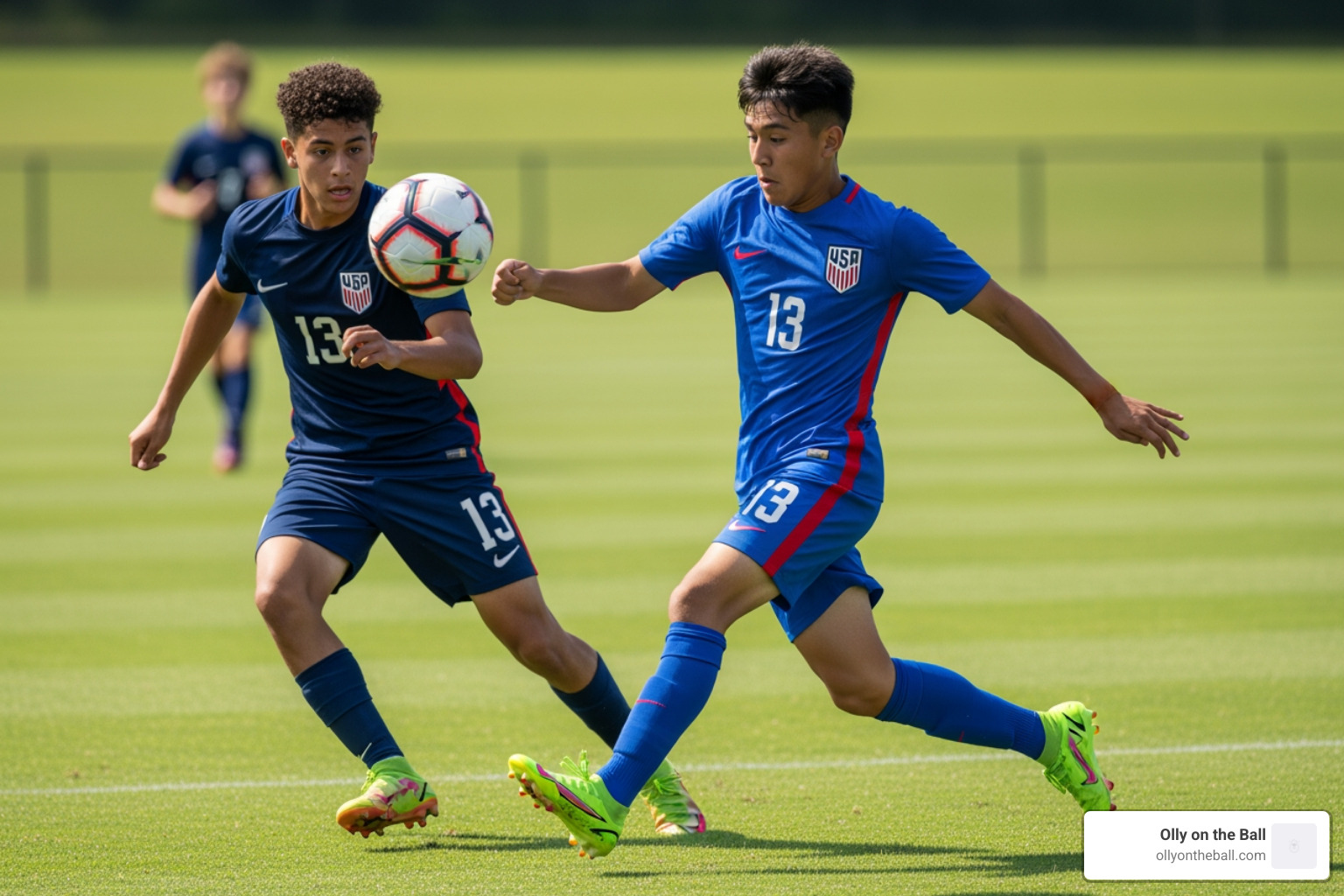
If you’ve ever watched a standard youth match at a park in James Island or Summerville, you’ve seen “the swarm.” Twenty kids chasing one ball, while half the players on the wings are picking grass or watching a plane fly over. That doesn’t happen in small sided soccer games.
The secret to why these games are so effective lies in the math. In an 11v11 game, a player might go five minutes without touching the ball. In a 3v3 or 4v4 game, that same player is likely to touch the ball every 30 seconds. According to research from organizations like England Football, small-sided football benefits and formats include significantly higher participation rates and more opportunities for goalkeepers to stay engaged.
When we run these sessions, we focus on three major pillars:
- Increased Touches: More touches lead to better ball control and technical mastery. It’s hard to get better at dribbling if you never have the ball at your feet.
- Constant Decision-Making: Because the space is tight, players have to decide before they receive the ball what they are going to do with it. This builds “game IQ” faster than any cone drill ever could.
- Player Responsibility: In a small group, you can’t hide. If you don’t track back, your team concedes. If you don’t move into space, your teammate has no options. This creates a sense of accountability and leadership.
At Olly on the Ball, we believe the game is the best teacher. By simulating real-game scenarios—like 2v1 overloads or quick counter-attacks—we help players develop the confidence to try new skills without the fear of failure. You can learn more info about our training philosophy and how we prioritize “Total Football” concepts, where every player learns to attack and defend interchangeably.
Setting Up Your Training Pitch in the Lowcountry
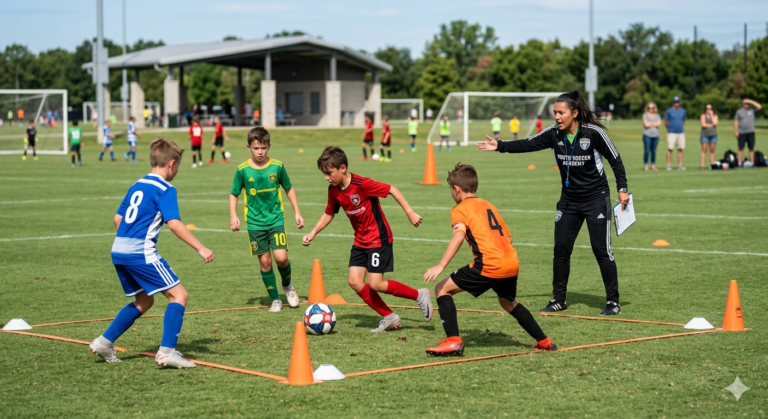
Setting up a session at a local spot like the Mount Pleasant Waterfront Park or a field in Daniel Island doesn’t require a truckload of gear. You just need a bit of space and the right dimensions to ensure the game flows correctly.
The size of the “pitch” is actually one of the most important coaching tools you have. If the field is too big, the game becomes a track meet. If it’s too small, the players get frustrated because they have no room to breathe.
| Age Group | Format | Field Dimensions (Yards) | Goal Type |
|---|---|---|---|
| U6 | 3v3 (No GK) | 15 x 20 | Cones or 4ft Pop-ups |
| U8 | 4v4 (No GK) | 20 x 30 | 4ft x 6ft Pop-ups |
| U10 | 7v7 / 8v8 | 45 x 70 | 6ft x 18ft |
| U12+ | 4v4 to 6v6 | 30 x 40 | Standard or Small |
To get started, follow these official rules for small-sided youth games as a baseline. For our private and small-group sessions, we usually stick to the following equipment list:
- Cones: To mark the boundaries and “end zones.”
- Vests (Pinnies): Essential for keeping track of who is on which team during high-speed transitions.
- Small Goals: We love using weighted pop-up goals or even just two cones to encourage accuracy over power.
- Extra Balls: Keep 5-10 balls near the coach or the sidelines to keep the “Murder Ball” intensity high—no waiting for kick-ins!
Rotation Strategy: We recommend playing short, high-intensity intervals. For U13 players, try 4-minute games with a 1-minute rest. This keeps the quality high and mimics the “burst” nature of real soccer.
Essential Formats for Small Sided Soccer Games
Not all small sided soccer games are created equal. Depending on what skill we want to master—be it possession, pressing, or finishing—we swap between several “tried and true” formats. You can check out more drill ideas on our blog for deep dives into these setups.
1. The Chaos Rondo (4v4 + 2 Neutrals)
This is a favorite for teaching players how to keep their heads up. We set up a standard grid but add two “Neutral” players who always play for the team in possession. This creates a constant 6v4 advantage, teaching the defending team how to stay compact and the attacking team how to exploit overloads.
2. Murder Ball
Don’t let the name scare you! This is just a high-intensity 3v3 or 4v4 game where there are no stoppages. If the ball goes out, the coach immediately throws a new ball in. This forces players to react instantly to transitions. It’s great for fitness and mental toughness.
3. End Zone Games
Instead of shooting on goals, teams score by dribbling into or passing to a teammate in a 5-yard “End Zone.” This is perfect for teaching “third-man runs” and movement off the ball. It stops players from just “booting it” and forces them to look for a creative pass.
4. 2v2 Combat
This is the ultimate test of individual skill. We use a small 10×15 yard grid. It’s fast, physical, and requires perfect ball control. If you can beat a defender in a 2v2, you’ll find the 11v11 game feels like it’s moving in slow motion.
5. One-Touch Restrictions
To level up a high-standard U13 group, we often implement a “two-touch max” or even “one-touch” rule. This forces players to scan the field before the ball arrives. If you take a third touch, it’s a foul. It’s probably the best way to improve spatial awareness.
Coaching Points for High-Intensity Transitions
As a coach or a mentor, the goal isn’t to shout instructions every five seconds. We want the players to figure it out. However, there are a few “Golden Rules” we emphasize during our sessions in Charleston. If you want a more hands-on approach, contact Olly for a personalized session plan.
The “3-Second Rule” (Counter-Pressing): When a team loses the ball, they have three seconds to win it back immediately. If they don’t, they must drop back into a defensive shape. This teaches the “transition” mindset that defines modern soccer.
1st and 2nd Defender Roles:
- 1st Defender: The player closest to the ball. Their job is to provide immediate pressure and “steer” the attacker away from the goal.
- 2nd Defender: The player providing cover. They need to be at a 45-degree angle, ready to step in if the first defender gets beaten.
Body Shape and Scanning: We constantly remind players to “check their shoulders.” Before receiving a pass, a player should know where the defenders are and where their teammates are. We coach them to receive the ball with an “open body shape”—facing the field, not just the person who passed it.
Exploiting Overloads: In a 3v2 situation, the attacking team should be taught to “fix” the defender. Dribble at them to force them to commit, then release the pass to the open teammate. This is the foundation of clinical attacking play.
Frequently Asked Questions about Small Sided Soccer Games
What is the best field size for a 4v4 game?
For most youth players (ages 8-12), a field roughly 25 yards wide by 35 yards long is the “sweet spot.” It’s large enough to allow for some passing combinations but small enough that defenders can still apply pressure quickly. If you want to focus more on dribbling and 1v1s, shrink it to 20×25.
How do SSGs help with game awareness for U13 players?
At the U13 level, the game moves from “recreational” to “tactical.” Small sided soccer games help because they force players to recognize patterns—like when to switch the play or when to press as a unit—much more frequently than a full-sided game. Because they see these patterns every minute, they become second nature during Saturday’s big game.
Can small-sided games be used for fitness training?
Absolutely. In fact, many professional teams use “Small Sided Games” instead of traditional “suicide” sprints. Because the games are high-intensity and involve constant changes of direction, they build “soccer-specific” fitness. Playing four rounds of 4-minute “Murder Ball” is often more exhausting (and fun) than running laps around the park.
Conclusion
The soccer culture here in the Lowcountry is incredible. From the fields at Isle of Palms to the competitive atmosphere in North Charleston, we have some of the best young talent in South Carolina. But to really stand out, players need more than just team practice—they need high-quality, high-repetition training.
At Olly on the Ball, we specialize in bringing that professional, high-intensity environment to a setting that feels like a peer-to-peer hangout. We aren’t here to lecture; we’re here to play, mentor, and master the fundamentals together. Whether it’s through small sided soccer games or one-on-one technical work, our goal is to build your child’s confidence and love for the game.
Ready to see the difference that focused, small-group training can make? You can find more info about private soccer coach Charleston SC on our services page.
Don’t let your player get lost in the swarm. Let’s get to work!