

Soccer agility training in Charleston is the work that turns players who are fast in a straight line into players who are fast when it matters — changing direction at full speed, exploding past a defender, recovering after a missed tackle. Straight-line speed is great for sprint races. Soccer is played in three-yard bursts, sharp cuts, and reactions to what the ball just did. That’s agility, and it’s a skill — which means it’s trainable, layerable, and measurable. This guide breaks down how soccer agility actually gets built for young players in the Mount Pleasant and Charleston area, what work moves the needle, and how to know if a training program is real agility work or just running with cones.
Charleston is a great place to train agility — long outdoor season, mostly grass available year-round, low ceiling between rec and competitive play that means there’s real room to separate by getting sharper. The players who do agility right by August tryouts look noticeably different to coaches.
Agility vs. speed vs. quickness — what’s the difference?
These three get used interchangeably. They’re not the same:
- Speed is how fast you cover ground in a straight line. Useful in soccer maybe 10% of the time.
- Quickness is how fast your feet move in a small space. Useful for ball mastery — quick touches, fast footwork in tight areas.
- Agility is the ability to change direction at speed, in response to a stimulus (the ball, an opponent, a teammate’s movement). This is what soccer is mostly made of. This is what young players need.
Real agility training has a reactive component. If you’re just running through a cone pattern at full speed, that’s quickness training with a memorized path — useful, but not the full picture. Real agility training adds the “respond to something” piece. Coach call, ball trigger, opponent movement.
What real soccer agility work looks like
For young players (ages 8-14), an effective agility session has three blocks:
Block 1: Mechanics (10-12 minutes)
Before you can move quickly, you have to move correctly. Mechanics work covers:
- Athletic stance — feet shoulder-width, weight balanced, knees bent, ready to push off either direction
- Foot strike — landing on the ball of the foot, not flat-footed
- Plant-and-cut technique — outside foot drives, inside leg recovers, hips rotate before the upper body
- Deceleration — most agility injuries happen on the stop, not the cut. Teaching kids to absorb speed before they change direction is non-negotiable
This is the boring part. It’s also the part that prevents the knee injuries that wreck youth seasons.
Block 2: Pattern work (15-20 minutes)
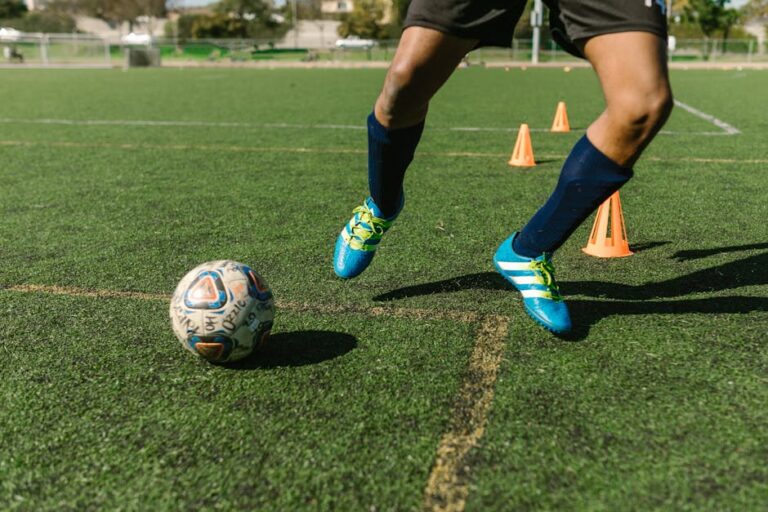
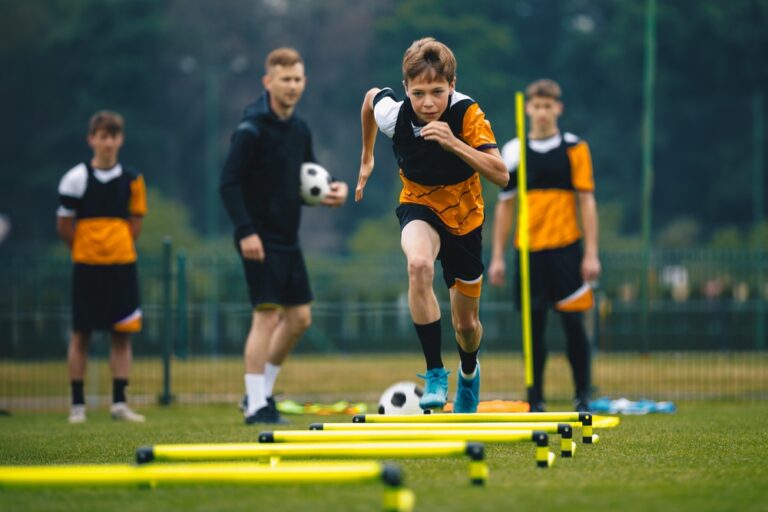
Now drills with cones, ladders, hurdles. The cones-and-ladder part of agility training that everybody recognizes. Done right, these build foot speed and direction-change rhythm. Done wrong, they’re just gym class.
What “done right” looks like: short bursts (3-5 seconds), full intensity, full recovery between reps. Sloppy reps build sloppy habits — slow down or stop if the form falls apart. Add a ball as soon as the pattern is locked. A cut drill with the ball at the foot is 10x more useful than a cut drill without it.
Block 3: Reactive agility (10-15 minutes)
The most underrated and most important block. The player has to respond to something — a coach point, a ball roll, a partner’s movement, a small-sided 1v1. The cut isn’t memorized; it’s chosen in real time. This is where agility actually transfers to game day.
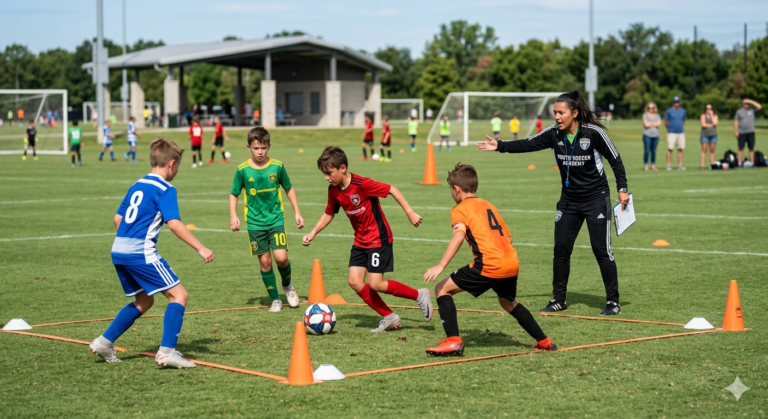
Example: two players face each other, ball at one player’s feet. The ball-carrier dribbles in any direction; the defender mirrors. After 5 seconds, the coach yells “ball” and the defender attacks. Both players are now reacting to what’s actually happening, not running a script. That’s the rep that matters.
Common agility-training mistakes to avoid
- All scripted, no reactive. If every rep is a memorized cone pattern, the player gets fast at memorized patterns — which doesn’t exist in a real game. Mix scripted and reactive every session.
- Too long, too tired. Agility is a high-intensity, full-recovery skill. 5-second efforts, 30-second rests. The moment fatigue sets in, mechanics collapse and you’re training bad habits.
- No ball. Agility training without a ball builds a faster athlete. Agility training with a ball builds a faster soccer player. The ball changes everything about how the body moves — train with it whenever the player can handle the technical demand.
- Same drills every week. The body adapts in 3-4 weeks. Rotate patterns, change direction sequences, add new reactive triggers. Variety keeps the nervous system learning.
What this looks like in Mount Pleasant + the Charleston metro
For Charleston-area young players, the best agility work tends to happen in two settings:
- Small-group sessions on grass. Park of the Edisto, Patriots Point, the fields off Long Point — anywhere with flat grass and 30 yards of space. Small group means real reactive 1v1 work, more reps per kid, less standing around.
- Backyard mechanics + pattern work. Mechanics drills and ladder/cone patterns translate fine to a driveway or a back lawn. The reactive piece is harder to do alone — that’s where a session with another player or a coach matters.
Heat factor in Charleston summers — late morning and early evening sessions outperform mid-day for both safety and quality. Hydrate aggressively. Agility work is high-CNS, and a dehydrated nervous system makes bad cuts.
A simple 4-week agility plan for young players
This works for any motivated player ages 8-14, two-three sessions per week, 30-40 minutes per session:
- Week 1 — Mechanics dominant. 70% mechanics, 30% pattern. No reactive yet. Build the base.
- Week 2 — Patterns introduced. 40% mechanics, 50% pattern, 10% reactive. Add the ball to about half the pattern work.
- Week 3 — Reactive layered in. 25% mechanics, 40% pattern, 35% reactive. Every session should include at least one ball-based 1v1 reactive game.
- Week 4 — Game-speed integration. 15% mechanics, 35% pattern, 50% reactive small-sided games. The work has to look like soccer by now.
After four weeks, repeat the cycle with new patterns and harder reactive triggers. This is how progressive overload looks for agility — not heavier, faster.
FAQ — Soccer agility training in Charleston
How young is too young for soccer agility training?
Age 7-8 is a reasonable floor for structured agility work. Younger than that, kids should be doing general athletic play — tag, climbing, running, jumping — which builds the same nervous-system foundation in a more developmentally appropriate way. Forcing agility patterns on a 5-year-old is usually counterproductive.
How long until soccer agility training shows up in real games?
Mechanics changes show up at 2-3 weeks (player visibly stops, starts, and cuts cleaner). Reactive agility transfer takes 6-8 weeks because the brain has to learn to apply the new movement patterns under defender pressure.
Does soccer agility training help with injury prevention?
Yes — significantly, when mechanics is trained properly. Most non-contact knee injuries in youth soccer happen on decelerations and bad-cut landings. Teaching kids to absorb speed and plant correctly is one of the best long-term investments in their soccer body.
Can my child do agility training at home or do they need a trainer?
The mechanics and pattern work can be done at home with cones and an honest video review. The reactive piece — the part that actually transfers to game day — needs another player or a coach who can change the trigger. A mix of home work and small-group sessions usually beats either alone.
What’s the difference between agility training and ladder drills?
Ladder drills are one tool inside agility training, specifically for foot quickness and rhythm. They’re not agility training by themselves — they don’t include the change-of-direction at speed or the reactive component. If a program is mostly ladder work, it’s quickness training, not agility training.
Quick feet. Quick decisions.
Agility wins more youth soccer games than anyone admits. The kids who can change direction at full speed are the ones who beat defenders, who recover from a missed tackle, who get to the ball first when it ricochets off a leg in the box. Train it on purpose, layer it correctly, and add the ball every chance you get. The agility gains stack on top of every other technical skill the player already has — making everything else more dangerous on game day.
If your player is in the Mount Pleasant or Charleston metro area and wants structured agility work — alone or in a small group — head to the contact page to start a conversation. For more on the speed side of the game, read speed of play — the #1 skill that separates good from great players and two change-of-direction moves with full drill explanations. To pair agility gains with sharper ball-on-the-foot work, see our backyard first-touch drill guide.