
Why Soccer IQ Development for Youth Is the Real Game-Changer
Soccer IQ development youth players need isn’t just about knowing tactics — it’s about seeing the game before it happens. Here’s a quick answer if you’re short on time:
How to develop soccer IQ in youth players:
- Scan constantly — check shoulders before receiving the ball
- Study the game — watch professional players in your position
- Play small-sided games — rondos, 3v3, 4v4 for faster decisions
- Focus on one concept at a time — don’t try to fix everything at once
- Reflect after games — journaling and video review build awareness
- Use tech tools — VR apps, cognitive training programs, and yes, even FIFA
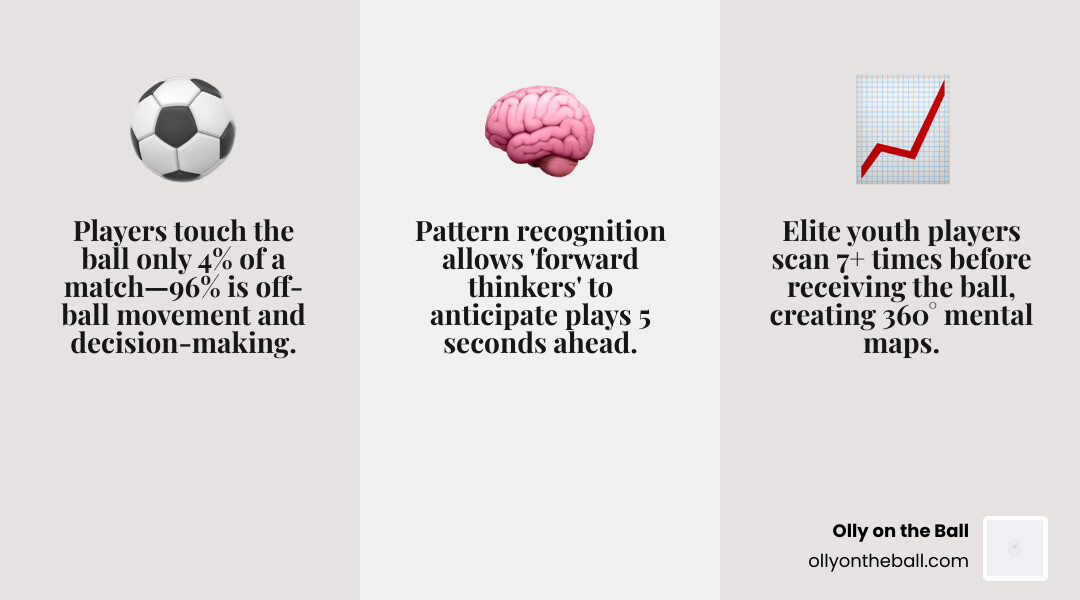
Here’s something most parents don’t realize: the average player touches the ball for just 4% of a game. That means 96% of the game is played without the ball — through movement, positioning, scanning, and reading what’s about to happen next.
That 96% is where soccer IQ lives.
Speed fades. Size changes. But a player who understands the game — who knows where to be before the ball arrives — that player keeps getting better as they get older. In the youth soccer scene here in Charleston and Mount Pleasant, the kids who stand out at tryouts aren’t always the fastest. They’re often the ones who think one step ahead.
The good news? Soccer IQ isn’t something you’re born with. It’s a skill. And like any skill, it can be trained.
Understanding Soccer IQ Development for Youth Players
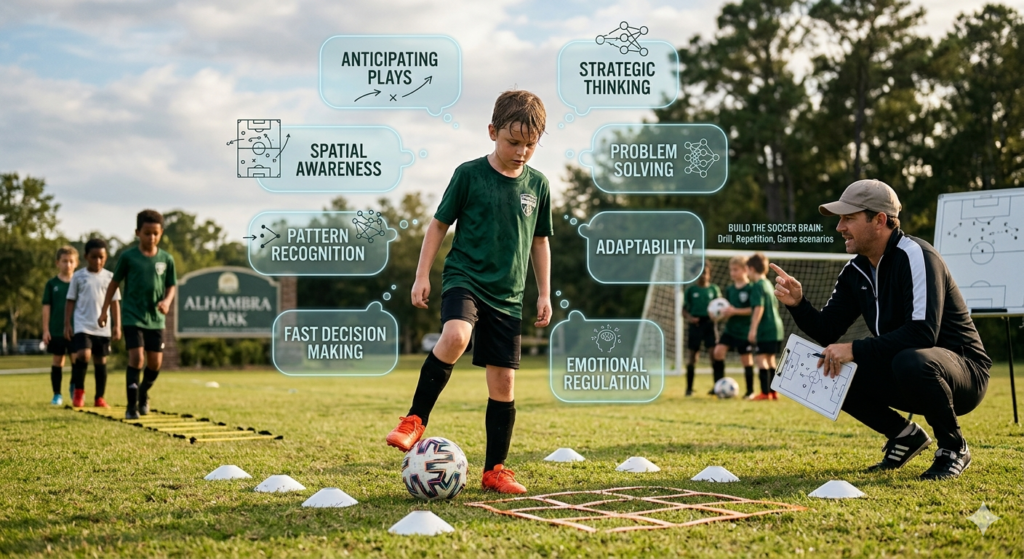
When we talk about soccer IQ development youth players need, we aren’t talking about memorizing a playbook. We’re talking about “cognitive development”—the brain’s ability to process what’s happening on the field in real-time. In the Lowcountry, from the pitches at Patriots Point to the complexes in North Charleston, we see plenty of “athletes.” But the “soccer players” are the ones who use pattern recognition to solve problems.
Soccer intelligence is essentially the ability to be a “forward thinker.” While a typical player reacts to where the ball is now, an intelligent player anticipates where the ball will be in five seconds. This involves constant shoulder checking (scanning) to create a 360-degree mental map of the field.
Research into elite youth development shows that top-tier players often accumulate thousands of hours of purposeful play where they are forced to make decisions under pressure. This builds a “confidence bank” of mental pictures they can call upon during a match.
Why the “Soccer Brain” Beats Pure Speed
We’ve all seen it: the kid who is a foot taller and twice as fast as everyone else dominating at U10. But by U14, the field levels out. This is where “late bloomers” with high soccer IQ take over. Pure speed is a great tool, but positioning and efficiency are what keep you on the field as the game gets faster.
Reading the game allows a player to intercept a pass without having to sprint 30 yards. It allows a midfielder to find a pocket of space just by taking two steps to the left. At Olly on the Ball, we focus on these fundamental skills because we know that technical ability—like a perfect first touch—is only useful if the brain knows where to direct that touch.
The Role of Scanning in Soccer IQ Development for Youth
Scanning is the “secret sauce” of soccer intelligence. Most youth players have a “ball-watching” habit. They stare at the ball until it hits their feet, and then they look up to see where the defenders are. By then, it’s usually too late.
Developing a 360-degree view means breaking the habit of ball-watching. We teach players to take “mental snapshots” every few seconds. By checking their shoulders before the ball arrives, they already know if they have time to turn or if they need to play a one-touch pass back to a teammate. This simple habit changes a player from being reactive to being proactive.
Core Principles of Play: The Building Blocks of Intelligence
To build a high soccer IQ, players need to understand the “Principles of Play.” These are the universal rules that govern how the game is played, regardless of the formation. Whether your child plays for a local club in Summerville or a travel team in James Island, these principles remain the same.

Mastering Transitions in Soccer IQ Development for Youth
The most chaotic moments in soccer happen during “transitions”—the seconds immediately after the ball changes hands. An intelligent player recognizes these mental triggers instantly. When we lose the ball, do we “counter-press” to win it back immediately, or do we drop back into a defensive shape?
Training these reactions often requires small-sided games where the ball moves quickly and players have no choice but to think fast. Speed of thought is often more important than speed of foot during a transition.
Defending with Intelligence over Force
Many young defenders think their job is just to kick the ball as hard as they can or run through the attacker. Real defensive intelligence is about the “angle of approach” and “jockeying.” It’s about creating “defensive triangles” with teammates to funnel the attacker into a dead end.
Communication is a massive part of this. A high-IQ defender doesn’t just watch the ball; they talk to their teammates, helping them adjust their positioning before the danger even starts.
Practical Training Methods to Boost Game Intelligence
How do we actually train the brain? It’s not through standing in long lines waiting to shoot. It’s through “game-like” scenarios.
- Rondos: These are possession games (like 4v2 or 5v2) in a small space. At the professional level, the ball moves every half-second. This forces players to constantly adjust their body position and recognize where the “open man” is.
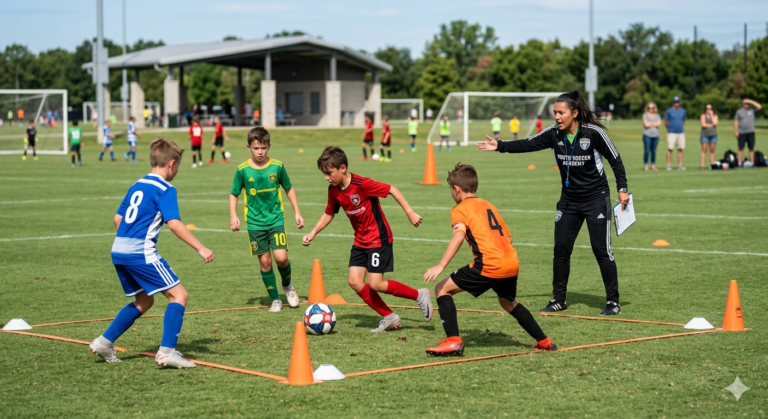
- Small-Sided Games (SSGs): 3v3 or 4v4 games provide more touches and more mistakes. Mistakes are the best teachers for soccer IQ because they provide instant feedback.
- Constraints-Led Approach: This is where we add rules to a game to force a specific behavior. For example, “you can only score after every player on your team has touched the ball.” This forces off-ball movement and awareness.
Using Technology for Game Understanding
We live in an age where soccer IQ can be trained from the living room. Platforms like SportsLab360 offer interactive modules that teach tactical concepts through video. There are even NASA-approved brain training programs like IntelliGym that have been shown to improve anticipation and awareness in as little as six weeks.
Virtual Reality (VR) tools like “Be Your Best” allow players to experience 11v11 scenarios from a first-person perspective, practicing their scanning and decision-making without the physical toll of a full match. And believe it or not, even playing FIFA (on a high difficulty setting) can help players visualize passing lanes and teammate positioning.
The Power of Reflective Practice
Elite youth development programs, like those recommended by U.S. Soccer, emphasize “reflective practice.” This means thinking about the game after it’s over.
- Journaling: Have your child write down one thing they did well and one thing they want to improve after every session.
- “Stop, Start, Stay”: When watching game film, ask: “What should I stop doing? What should I start doing? What should I stay (keep) doing?”
- Confidence Bank: Noting small successes helps build the mental resilience needed to try creative plays during a high-pressure match.
How to Train Your Soccer Brain at Home
You don’t need a full team to improve soccer IQ development youth players need. Parents can play a huge role here by making the game a topic of conversation.
Watching professional games is the best “homework” a player can have. However, don’t just follow the ball. Pick one player who plays your child’s position and watch only them for 10 minutes. What do they do when the ball is on the other side of the field? How often do they scan?
| Feature | Men’s Pro Games (e.g., Premier League) | Women’s Pro Games (e.g., NWSL) |
|---|---|---|
| Primary Focus | High physical speed and explosive power | Often more tactical and technical-heavy |
| Learning Value | Great for seeing “speed of thought” | Excellent for seeing shape and patterns |
| Youth Relatability | Can be hard to replicate the athleticism | Very relatable for tactical positioning |
Books like Soccer Starts at Home by Tom Byer emphasize that the earliest stages of “game feel” happen in the backyard or the hallway. You can even turn game-watching into a family quiz: “Where is the space right now?” or “Who is the most dangerous player on the field?”
Frequently Asked Questions about Soccer IQ
Can you really teach soccer intelligence?
Absolutely. While some players have a natural “feel” for the game, soccer IQ is largely a collection of recognized patterns. Through deliberate practice and repetition, the brain creates “shortcuts.” This is known as neuroplasticity—the brain actually re-wires itself to recognize soccer scenarios faster the more it’s exposed to them.
At what age should we start focusing on tactics?
For younger kids (U6-U10), the focus should be on “me and the ball.” But as they move into the U12-U17 phases, the “me and the team” aspect becomes crucial. We introduce age-appropriate concepts—like basic spacing—early on, but we always keep it fun. If it’s not fun, they won’t have the passion to do the deep thinking the game requires.
Does playing FIFA actually help a player’s game?
Yes, but with a caveat. If they are just doing “trick shots,” it won’t help much. But if they are playing realistically, it helps with “pass visualization” and spatial awareness. It allows them to see the whole field from a “birds-eye view,” which helps them understand why a coach asks them to “stay wide” or “tuck in.”
Conclusion: Start Your Journey in Charleston Today
Building a “soccer brain” is a marathon, not a sprint. It takes patience, a lot of watching, and even more playing. Here in the Charleston and Mount Pleasant area, we have a vibrant soccer culture, and the competition is only getting stronger.
At Olly on the Ball, we believe that every child can develop a high soccer IQ if they are given the right environment to ask questions and make mistakes. As a peer-led training service, we don’t just teach drills; we share the “why” behind every movement. We want to inspire a love for the game that goes beyond just kicking a ball—we want to build the next generation of intelligent, confident Lowcountry players.
Ready to take your child’s game to the next level? Whether they need to work on their scanning, their first touch, or their overall game awareness, we’re here to help.