

The fastest way to improve your weak foot is to use it when it doesn’t matter. Fifteen minutes a day of left-foot-only ball work — sole rolls, wall passes, easy touches with nobody watching — does more than trying to shoot with it in a game and getting embarrassed. Weak foot ability isn’t talent. It’s reps you haven’t done yet.
I’m Olly. I play for Surf and coach younger players around Mount Pleasant, and this is one of the most common things I get asked to fix. Here’s the drill progression I actually use.
Why it matters more than it used to
Watch any young player who’s one-footed and you’ll see the same thing: they take an extra touch to get the ball onto their good side. That extra touch is half a second, and half a second is the difference between a shot and a block, or a pass and a tackle.
Defenders work it out fast. By about U11, opponents start showing one-footed players onto their weak side deliberately, because they know what’ll happen. A player who can go either way is genuinely twice as hard to defend.
The good news is that this is one of the most fixable things in the game. It just needs volume.
The rule that makes it work
Before the drills, the principle: use your weak foot where the pressure is lowest.
Most players try to use their weak foot for the first time in a game, mishit it, feel stupid, and never try again. That’s backwards. Build it in the yard where nothing’s at stake, then in training, then in games. By the time it appears in a match it should feel unremarkable.
Stage 1 — Getting used to the feeling (weeks 1–2)
Pure familiarity work. No pressure, no speed. Ten minutes a day.
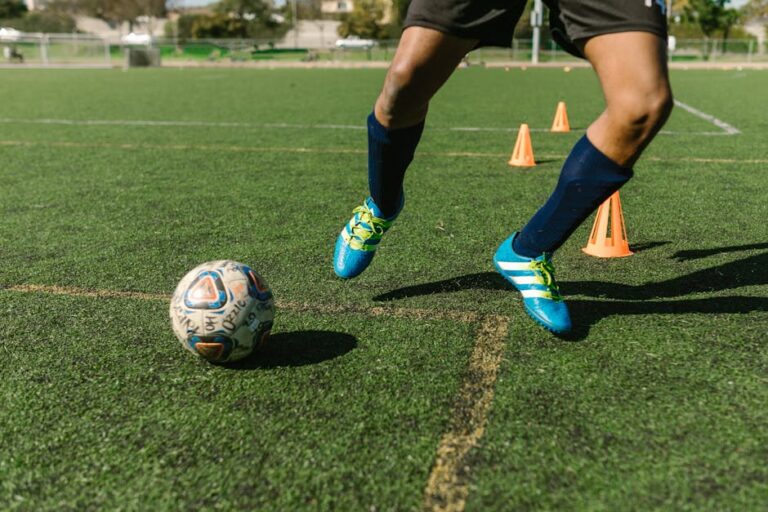
- Weak-foot sole rolls. Roll the ball side to side with the sole of the weak foot only. 60 seconds, rest, repeat three times.
- Weak-foot taps. Tap the top of the ball with the weak foot, standing foot planted. Light and quick.
- Inside-outside touches. Move the ball across the body using the inside then the outside of the weak foot. Walk forward as you do it.
- Weak-foot toe taps against a curb or step. Boring, effective, and you can do it while talking to someone.
This stage feels awkward. It’s meant to. The foot has genuinely never done these movements before. This is the same foundation as any ball control work — just on the side that’s behind.
Stage 2 — Passing and receiving (weeks 3–4)
Now add a wall. A wall is the best training partner a young player can have — it never gets bored and it always passes back.
- Weak-foot wall passes. Stand eight yards from a wall. Pass with the weak foot, control with the weak foot, repeat. 50 reps. Focus on a clean strike with the inside of the foot, not power.
- Two-touch wall work. Receive with the weak foot, take a settling touch, pass with the weak foot.
- Weak-foot first touch out of the air. Throw the ball up, cushion it down with the weak foot, then pass it against the wall.
- Alternating. Right foot pass, left foot pass, right, left. This is the one that starts to feel like real soccer.
Coaching point: the standing foot is where most weak-foot problems actually live. Point it where you want the ball to go. If your standing foot is wrong, the pass will be wrong no matter which foot strikes it.
Stage 3 — Moving and dribbling (weeks 5–6)
Add movement and a bit of speed.
- Weak-foot-only dribbling. Set out four cones in a line, ten yards apart. Dribble the whole way using only the weak foot — inside, then outside. Both directions.
- Weak-foot cuts. Dribble forward, cut back sharply with the inside of the weak foot, accelerate away. This one shows up in games constantly.
- Figure-eights. Two cones five yards apart, weave through them weak foot only.
- Weak-foot 1v1 moves. Pick one move — a cut, a chop, a stepover — and drill it exclusively on the weak side.
Once the touches are reliable at walking pace, take them up to game speed. Speed exposes everything, which is exactly why you want it here rather than in a match — and it’s the same principle behind agility training for young players. There’s more on this progression in dribbling and footwork drills for kids.
Stage 4 — Finishing (weeks 7+)
The bit everyone wants to start with. Do it last, because a bad weak-foot shot is discouraging in a way a bad weak-foot pass isn’t.
- Weak-foot passing into an empty net from ten yards. Placement, not power. Inside of the foot.
- Weak-foot side-foot finishes from a rolling ball, played across the body.
- Weak-foot laces strikes from twelve yards. Now you can hit it properly — and by now the technique will hold.
- One-touch weak-foot finishes from a wall rebound.
The key with finishing: accuracy first, power much later. A young player who tries to blast their first weak-foot shots will develop bad technique and reinforce the idea that the foot doesn’t work.
The 15-minute daily weak foot soccer drills routine
If you only do one thing, do this. It works because it’s short enough to actually happen every day.
- 3 minutes — weak-foot sole rolls and taps
- 5 minutes — weak-foot wall passes, aiming for 100 touches
- 4 minutes — weak-foot dribbling through cones or around the yard
- 3 minutes — weak-foot finishing at a goal, a fence, or a marked spot on the wall
Every day for six weeks is roughly 25,000 weak-foot touches. That’s what changes a foot.
Bringing it into games
Small steps, or it won’t stick.
- Warm-ups first. Do the whole pre-game passing block on the weak foot only. Zero risk.
- Then simple passes in games. Sideways and backwards passes with the weak foot. Nobody notices if one goes astray.
- Then first touch. Stop moving the ball onto the good side automatically. Take it in with whichever foot is nearest.
- Then everything else. By this point the foot works, and it’s just a habit to break.
Most players stall at step three, because taking the ball on the weak side under pressure requires actual trust. That trust comes from having done it ten thousand times where it didn’t matter.
FAQ
How long does it take to improve your weak foot in soccer?
With fifteen focused minutes a day, most young players see a real difference in six to eight weeks. Passing and first touch improve first; finishing takes longer. It’s about volume, not natural ability.
What are the best weak foot drills for young players?
Start with sole rolls and taps for familiarity, move to wall passes for repetition, then weak-foot-only dribbling, then finishing. Wall passes give you the most reps per minute of anything on the list.
Can you become fully two-footed?
Genuinely equal is rare, even among professionals. But you can absolutely get your weak foot to the point where defenders can’t show you onto it, and that’s what actually matters in a game.
What age should players start weak foot training?
As soon as they’re comfortable with basic ball control — usually around seven or eight. The younger it starts, the more natural it feels, because the habit of avoiding the weak foot hasn’t hardened yet.
Why is my child’s weak foot so much worse?
Because they’ve never used it. Players naturally favour one side from the first time they kick a ball, and every rep after that widens the gap. It’s a usage problem, not a coordination problem.
Should players use their weak foot in games before it’s ready?
Not for shots or key passes early on. Start with low-risk sideways passes and first touches. Forcing it in high-pressure moments too early usually knocks confidence and sets the process back.
Put in the reps
Weak foot work isn’t glamorous, and it’s one of the few things in soccer where the result is almost guaranteed if you do the work. Fifteen minutes a day. That’s the whole secret.
If your player wants someone watching the technique so the reps are building the right habits, get in touch about a session — weak foot work is one of the easiest things to fix with a coach next to you.
About Olly: Oliver “Olly” Sovenyhazy is a 16-year-old soccer player with Surf and a volunteer with the professional Charleston Battery. Through Olly on the Ball he coaches private, semi-private and small-group sessions for young players across Mount Pleasant and the Charleston area — building confidence through reps, and skills that hold up in real games.