


Youth soccer in the U.S. is often seen as a pyramid of levels, from casual rec leagues at the base to elite academies at the top. As a 16-year-old who lives and breathes soccer, I’m here to rank all the major youth soccer levels – from GOAT status to, well, just for fun. Buckle up! (US Youth Soccer Pyramid Explained: Levels, Leagues, and Development Paths – Multi Ground Boots)
Hi, I’m Oliver “Olly” Sovenyhazy – a soccer-obsessed 16-year-old from South Carolina. I play for my club, Surf, and even volunteer with our pro team, the Charleston Battery, where I soak up tips from the pros and bring those lessons to younger kids I coach. My dream is to go pro, and I’ve learned a ton about the different paths you can take. So, let’s break down all the youth soccer levels in the US, from best to not-so-best, in my Gen-Z, soccer-loving perspective. (No cap, this is gonna be both informative and a little funny.)
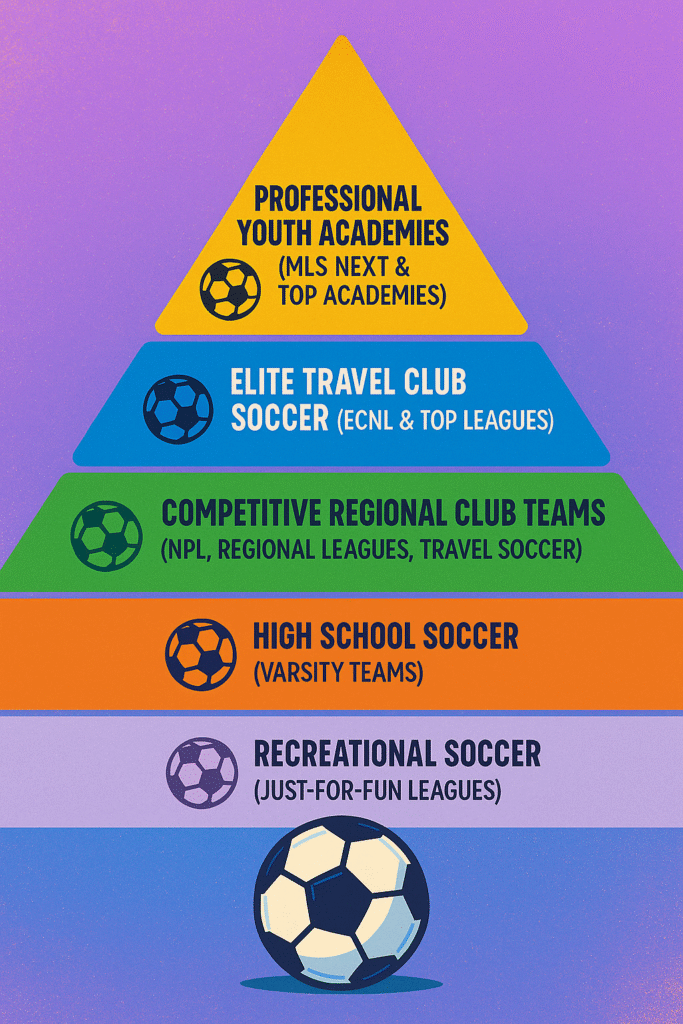
1. Professional Youth Academies (MLS Next & Top Academies)
Short Description: This is the absolute top tier of youth soccer – the big leagues for kids. Think MLS Next teams (the academy league run by Major League Soccer) and other professional club academies. If youth soccer levels were a video game, this is the final boss level. You’re training basically every day under professional coaches, playing against the nation’s best. It’s often affiliated with pro clubs (MLS or sometimes USL clubs), which means you’re on the radar of professional scouts all the time . Players at this level eat, sleep, and breathe soccer (and probably spend more time at practice than on homework, shh don’t tell my teachers).
Pros:
- Elite Training & Competition: Top coaches, top facilities, and top competition. You improve fast because you’re practicing with future stars and getting pushed hard every day .
- Direct Path to Pro: This is the most realistic path to a pro contract. MLS Next academies are literally designed to produce pro players – MLS clubs often sign their academy kids to professional contracts (some as young as 15 or even 14, no joke) (14-year-old Cavan Sullivan signs record MLS deal that includes Man City move | Philadelphia Union | The Guardian). You could be a high schooler with a Major League Soccer deal – crazy, right?
- College Opportunities: Even if you don’t go pro immediately, colleges love academy players. You’ll have a great shot at scholarships because you’re battle-tested against top competition.
- Sometimes Free: If you’re in an official MLS academy, they usually cover most costs (training, travel, etc.), making it accessible if you’re good enough to get in. That’s a huge W for your parents’ wallets.
Cons:
- Ultra High Commitment: It’s basically a full-time job. Seriously, you might train 4-5 days a week, travel every other weekend, and miss a lot of the normal teen life stuff. (Say goodbye to lengthy family vacations – you’ve got tournaments.)
- No High School Soccer: Most pro academies don’t allow you to play for your high school team or other sports (MLS NEXT vs. ECNL vs. GA: How to Choose Your Soccer League). FOMO alert: you might miss out on representing your school or going to prom because you’re traveling for soccer.
- Pressure Cooker: It’s intense and can be stressful. You’re always fighting for your spot because the level of talent is insane. It’s a grind that not every kid (or parent) can handle emotionally.
- Travel & Cost (if not subsidized): If you’re not in an MLS-backed free academy, the travel is coast-to-coast and the costs can be hefty. Many families shell out thousands per year on fees and travel (averaging around $8,000 a year for top league play) (MLS NEXT vs. ECNL vs. GA: How to Choose Your Soccer League) unless the club covers it. So yeah, it can be bougie and not everyone can afford it.
College/Pro Path: This level offers the best shot at going pro or earning a D1 college scholarship. Professional academies are literally built to create future pros – MLS Next is “working to pave a direct path for academy players to go pro”. Many MLS players have come straight from these academies as homegrown signings. For example, in 2024 a 14-year-old in an MLS academy signed a pro contract with a plan to join Manchester City at 18 – wild! If you crush it at this level, you might get a pro contract before you even graduate high school. And if not, college coaches absolutely know the quality here and scout academy games heavily. In short, academies can 100% lead to scholarships or pro contracts (for those who excel).
2. Elite Travel Club Soccer (ECNL & Top Leagues)
Short Description: Right below the pro academies, we have elite club leagues like ECNL (Elite Clubs National League), MLS Next teams that aren’t affiliated with an MLS pro club, and other national-level leagues. This is high-level club soccer – often called “travel soccer” on steroids. You’ll play in big showcase tournaments and leagues against top clubs from around the country. It’s super competitive, but unlike MLS academies, many players here do still play for their high schools or other sports on the side. It’s kind of the best-of-both-worlds for serious players who maybe aren’t in a pro academy location or want a bit more flexibility. These teams still train a lot (maybe 3+ times a week) and travel long distances for games. ECNL, in particular, has a reputation as one of the premier platforms for college recruiting in the U.S. – their national events are swarming with college scouts.
(This is actually where I play currently – grinding it out in the national league with SC Surf)
Pros:
- High Competition & Skill Growth: You’re still playing really high-caliber soccer. The speed and skill level are just a notch below academy, and you’ll get better by facing strong opponents regularly.
- College Exposure: Huge plus here – college coaches love scouting ECNL and similar elite club events. In fact, ECNL’s national showcases are considered the best recruiting events for college soccer in the country (hundreds of coaches show up). If your goal is a college scholarship, this path is tried-and-true – exposure is almost guaranteed at the big tournaments.
- Some Balance & Flexibility: Many elite clubs (especially in ECNL) allow or even encourage players to participate in high school soccer or other sports if they want. So you can be a baller for your club team but still enjoy representing your school, which is pretty cool. It’s not as all-consuming as an MLS academy schedule.
- Strong Coaching & Resources: These clubs usually have licensed, experienced coaches and good resources (though maybe not quite the pro academy level facilities). You’ll still get excellent training and development.
- Camaraderie and Travel Fun: Traveling to out-of-state tournaments with your teammates can be a blast. Long van rides, hotel shenanigans, and team TikToks – it’s memorable and builds lifelong friendships.
Cons:
- Cost is Still High: Elite club soccer = elite price tag. It’s a pay-to-play model for the most part. Between club fees, uniforms, flights/hotels, showcase fees, etc., families often pay several thousand dollars per season (roughly in the same ballpark as academies – could be $5k-$10k a year). It can be a real strain on the budget (sorry, mom and dad!).
- Heavy Travel & Time: You’re on the road a lot for games or showcases (though maybe slightly less than an MLS academy). It can eat up your weekends and school breaks. Say goodbye to lazy weekends; you’ll be spending them at airports or on 8-hour bus rides to the next tournament.
- Highly Competitive for Spots: Making an ECNL team itself is tough – there are tryouts and not everyone makes it. Within the team, playing time isn’t guaranteed. It’s competitive, and there’s pressure to perform to keep your spot.
- Not a Direct Pro Pipeline: While the competition is great, this route isn’t as directly tied to professional teams. It’s more geared towards college. You might be a superstar in ECNL, but if you want to go pro at 18, you might need to still get noticed and invited into a pro environment. It’s a bit less straightforward to jump to pro compared to an MLS academy (though it’s not impossible – some players do get there via college or later trials).
- Overlap and Burnout: Balancing high-level club and high school soccer can be exhausting. Two teams at once means double the games (and double the chances of injury or burnout). You’ll need good time management to handle school, club training, high school season, and oh yeah, some semblance of a social life.
College/Pro Path: College scholarships? Absolutely, yes. This level is a feeder to college soccer. A huge percentage of boys playing D1 or D2 soccer came through elite club leagues. In fact, around 77% of men’s college soccer players played on a club team in high school (High school vs club sports: Understanding the benefits), and leagues like ECNL are a big reason why. The ECNL specifically has a proven system for getting players seen by college coaches – if you ball out here, you’ll very likely get college offers. Professional contracts? Possible, but less common straight from club. More often, an ECNL player might go to a strong college program and then go pro, or try to join a pro academy at 17-18. There are exceptions – a few might get youth national team attention or trials with pro clubs – but realistically, this path is about setting you up for college, which in turn can lead to pro. It’s a slightly longer game for the pro dream. Still, if you’re exceptional, scouts won’t ignore you. (I’ve heard of some players getting looks from European clubs even from top U.S. clubs, but it’s rare.)
3. Competitive Regional Club Teams (NPL, Regional Leagues, Travel Soccer)
Short Description: This is the “pretty good” travel soccer level. Not every player is in an ECNL or MLS academy – there are tons of strong regional leagues and clubs that compete at state and regional levels. Examples: NPL (National Premier Leagues), US Youth Soccer National League conferences, regional club leagues like EDP, and so on. These teams practice a few times a week and play other clubs in the area or neighboring states. It’s still competitive soccer with tryouts, paid coaches, and travel tournaments, but the scope is more regional than national. Think of it as the middle tier: you’re above the local recreational or town league, but a notch below the elite national scene.
Pros:
- Solid Competition & Development: You’ll play against other good teams in your state/region, especially in State Cup or regional tournaments. Many talented players are at this level, so you still improve a lot and get quality game experience.
- Less Intense Commitment: Compared to the top tiers, the schedule might be a bit more forgiving. You usually won’t travel cross-country regularly – mostly weekend games a few hours away, maybe a big tournament or two per season. This means you might have a bit more life outside soccer.
- Play High School and Other Sports: There are typically no restrictions here on playing high school soccer or anything else. Most players at this level do both club and high school. You get the joy of school soccer and the benefits of club training – the best of both worlds for many.
- Pathway to Move Up: If you excel at this level, you can get noticed and move up to an ECNL team or even an academy. Or your whole club might earn promotion into higher leagues. It’s a stepping stone; plenty of late bloomers start here then get recruited upward.
- More Local Recognition: You’re often playing with and against local talent, so you become well-known in your area. The community vibe can be strong – local newspapers might mention your club’s tournament win, etc. It feels good to dominate your region if you can.
- Costs and Travel More Manageable: It’s still travel soccer (so it’s not cheap), but generally costs are lower than ECNL/Academy since travel is regional, not national. Fewer flights, more carpools. Your parents will thank you for not having to fly to California every other month.
Cons:
- Varied Level of Play: The competition can be a mixed bag. Top teams at this level are very good, but you’ll also face some weaker teams occasionally and win like 8-0. The consistency of high-level play isn’t as high as ECNL/academy, where basically every match is a battle.
- Less Scout Exposure: This is the “you have to work to get noticed” level. College coaches and national scouts won’t automatically be at your games. You might need to attend college ID camps, or your club enters showcase tournaments to get in front of scouts. If you stay at this level, you can still get recruited, but you and your coaches will likely have to be proactive.
- Pay-to-Play & Travel: Yes, you’re still paying to play. Club fees, uniforms, travel costs – it adds up, though usually not as insane as the elite tier. It’s competitive soccer in America, so the pay-to-play struggle is real here too.
- Fewer Resources: Coaching can be hit or miss. Some regional clubs have fantastic coaches, but others might have part-time coaches or volunteer coaches. Facilities might be just local parks, not the fancy turf fields and stadiums you’d see in an academy. You might have less conditioning or physio support, for example.
- Can Be Overlooked: Sometimes players at this level feel like “if you’re not ECNL or academy, do you even exist to scouts?” It can be discouraging if you compare yourself to those in higher leagues. You have to keep grinding and not everyone around you will believe you can go pro from here (prove them wrong!).
- Competition for Spots (to Move Up): Within your team it might be fine, but if you’re trying to jump to an ECNL or MLS academy, there’s fierce competition. You might dominate locally but still not make that jump, which can be frustrating if your area doesn’t have higher opportunities.
College/Pro Path: It’s possible to earn college scholarships from this level, but you have to be realistic and proactive. Many players on strong regional teams do go on to play in college, especially at local universities, D2, D3, or NAIA schools. Top players might still get D1 looks, especially if they also play high school and excel there, or attend showcase camps. You might not have coaches flocking to your games by default, but if you’re good, you can get on their radar. (Fun fact: even at this level, college scouts sometimes attend big regional tournaments or State Cup finals, so it’s not like you’re invisible – you just have to shine when it counts). As for pro contracts, coming straight out of a regional club to pro is pretty rare in 2025. Typically, if you aspire to go pro from here, you’d either move up to an academy at 16-17 or go the college route then try pro. Another emerging route is via USL Academy teams or lower-division clubs – for instance, some USL Championship teams (like my hometown Charleston Battery) look at local club standouts and might bring them into training or their U23 squads. But realistically, without hitting an elite level next, the pro dream out of high school is a long shot. It’s usually: dominate here, get into a good college program (maybe on a scholarship if you impressed enough), and then if you kill it in college, go pro. So yes, college is attainable from this level (though not guaranteed), but a direct pro contract is unlikely unless you use it as a springboard to something bigger.
4. High School Soccer (Varsity Teams)
Short Description: Ah, high school soccer – the pride of repping your school colors, the student section cheering (or heckling), and the chance to be the hometown sports hero. High school soccer is a unique level because it’s organized by your school, not by clubs. The level of play can vary wildly depending on your region and school size. Some high school teams are loaded with academy-level players (who temporarily leave club to play for school), while others might have kids who only play during the school season for fun. The season is usually short (like 2-3 months) and intense, with multiple games a week. For many, it’s more about school spirit and camaraderie than player development. I’m a sophomore, and playing for my high school team is a blast – the whole school knows if we win or lose, and there’s a special pride in it that you don’t get from club. But I also know it’s not the highest caliber soccer out there. Here’s the lowdown:
Pros:
- School Pride & Fun: There’s nothing like wearing your school jersey and scoring in front of your classmates. You get announcements on the school intercom when the team does well, maybe a photo in the yearbook, and bragging rights in the hallway. The vibe is hype – student fans, local rivalries (“Beat Lincoln High!” chants), maybe even a homecoming game. It’s a more social atmosphere than most club games.
- Play with Friends: Often, you’re playing with your best friends and classmates, not just a select travel team. The chemistry and memories you build are awesome. Bus rides to away games, team dinners, goofy locker room moments – it’s a core part of the high school experience for athlete kids.
- Less Travel Hassle: All your games are local (within your region or conference). Your “away” games might just be the next town over. No crazy travel – mostly just hopping on a school bus. Your family can come to all your home games easily.
- Different Competition Style: High school soccer can teach you to be tough. You might play against older kids (seniors vs. freshmen is a big gap), and the play can be very physical. Conditions might be rough (bumpy grass fields or even football fields with funny lines). It’s a scrappier, high-energy game which can toughen you up.
- Multi-Sport Friendly: Because it’s a defined season, you can play high school soccer and then play another sport in a different season if you want (or focus on club in the off-season). It allows you to be a more well-rounded athlete or take a break from year-round soccer grind if you need it.
Cons:
- Wide Range of Skill Levels: The talent spread is huge. You might have club stars and total newbies on the same field. Some games will be competitive, but others might be laughably one-sided or a bit chaotic in quality. If you’re used to high-level club play, it can be frustrating when teammates or opponents don’t have the same tactical skills.
- Short, Compressed Season: High school season is over in a blink. You play a ton of games in a couple of months, often without much rest. The focus is on winning for the school, not necessarily developing your skills. Once the season’s done, that’s it until next year.
- Coaching Quality Varies: Not every high school has a great coach specialized in soccer. Your coach might be a history teacher who happens to coach soccer on the side. Some coaches are awesome, but others might not even know tactics beyond “kick it to the fast kid.” Also, training can be old-school (lots of running laps, less technical work).
- Limited Exposure: College recruiters generally do not rely on high school games to scout top talent . Most recruiting happens via club soccer. So you could be the state’s player of the year in high school and still not get noticed by colleges if you’re not doing the club/showcase circuit. High school stats and accolades alone carry less weight with college coaches nowadays.
- Conflict with Club: If you do play at a high competitive club, sometimes the high school season can conflict. In some cases, club coaches worry about injuries or burnout. And if you’re in an MLS academy, you’re not even allowed to play high school (so many top players are missing from high school teams). This means some high school teams are weaker because the best players in the school don’t play, especially in big soccer metro areas.
- Facilities/Resources: Depending on your school, the field quality and equipment might not be great. You might be playing on the football field with temporary goals, or sharing worn-out uniforms that have been around for 5+ years. It’s not as fancy as club.
College/Pro Path: Here’s the reality check: High school soccer by itself is usually not enough to get you a college scholarship or a pro deal. Almost all college-bound players also play club. In fact, one survey showed about 77% of men’s college soccer players played club (and a huge chunk did both high school and club). College coaches are busy in the fall (when high school season happens for boys in many states) because it’s their college season too. They don’t have time to roam around random high school games – instead they hit the big club showcase tournaments later or watch video. So, if a kid only plays high school and no club, they’re likely off the radar. That said, high school can complement your club resume. If you’re the Gatorade State Player of the Year or your team wins state championship, that’s a nice brag and can catch an eye, but it’s usually alongside club performance. For pro: realistically, no MLS scouts are hanging out at high school playoffs hoping to sign a kid (they’re at academy games). There have been rare cases of a phenom being spotted in high school, but nowadays it’s rare. If going pro is the goal, high school soccer is more for fun and pride; you’d need to also be in an elite environment outside school. So enjoy high school for what it is, but if you want a scholarship or contract, club/academy is where you make that happen.
(Side note: I love playing for my school because it’s a different kind of fun – my whole family comes to games, and I got voted team captain as a sophomore which was awesome. But I’m fully aware that if I want colleges to notice me or to go pro, it’s my club performance and offseason showcases that matter more. Gotta hustle year-round.)
5. Recreational Soccer (Just-for-Fun Leagues)
Short Description: This is the entry level and casual level of soccer – the foundation of the pyramid. Recreational (“rec”) soccer is all about fun, friends, and learning the game with minimal pressure. This is typically run by local community clubs, YMCAs, or AYSO and parks & rec departments. Everyone can play; there are usually no tryouts. Teams are often coached by volunteer parents, and the vibe is super chill. Think Saturday morning games where kids wear reversible jerseys, play shorter matches, and the biggest reward is the post-game snack. Ages range from little 5-year-olds chasing butterflies on the field up to teenagers who just want to play casually. I started in rec when I was little (as most of us do), and it’s where you fall in love with the sport. But as you grow, if you get serious, you move on to competitive club from here. Rec is basically Soccer 101 – and also a fun place to stay active without the crazy commitment.
Pros:
- Pure Fun & Love of the Game: Rec soccer is purely for the enjoyment of the sport (PowerPoint Presentation). The focus is on having fun, making friends, and learning basic skills. It’s low-pressure. You get to experience the joy of playing without coaches yelling about tactics or having to run sprints for losing. This is where you truly learn to love soccer.
- Inclusive & Welcoming: Everyone gets to play, regardless of skill. There’s a team for you whether you’re the next Messi or just there to socialize. Equal playing time is usually a thing. It’s great for kids who are new to soccer or who don’t want the intensity of travel teams.
- Local & Convenient: Games are at the local park down the street. No travel beyond maybe the next town. One or two practices a week, a game on the weekend – easy peasy. It fits nicely around school and family life. Parents love it because it’s not a huge time or money sink.
- Emphasis on Basics: You actually learn fundamental skills and sportsmanship. Coaches (often volunteer dads/moms) focus on teaching how to dribble, pass, teamwork, etc., without the pressure of winning at all costs. It’s developmental in a very foundational way.
- Family and Community Atmosphere: It’s super family-friendly. Siblings playing in the playground next to the field, grandparents coming to watch, team snacks, everyone cheering every goal (for both teams). It’s wholesome. Orange slices at halftime have never tasted so good.
- No Major Cost or Tryouts: Rec leagues are cheap or sometimes free. No crazy fees – mainly just the cost of a jersey and shin guards. And no one gets cut; you sign up, you play. That’s awesome for accessibility.
Cons:
- Low Level of Play: Let’s be honest, the quality of soccer is… not great (and that’s fine!). The skill range is huge, and a lot of players are beginners. If you’re a skilled player, you might get frustrated because it’s not very challenging. Teams might have kids who barely know which goal to attack. Scorelines can be all over the place, but often they don’t even officially keep score for younger ages.
- Minimal Training: Practices are limited and coaches might not be super knowledgeable (plenty of “team parent” coaches who might be learning the game too). There’s not much tactical or advanced skill training. It’s more like herding cats, especially with young teams. So development beyond basics can stall if you stay in rec too long.
- No Competitive Path: Rec is not about competition. There’s usually no playoffs or serious tournaments (maybe a fun day or a small local tourney at most). If you have a competitive spark, you’ll outgrow rec quickly.
- Limited Advancement: If your dream is to play in college or pro, rec alone won’t get you there. It’s not designed for that. You won’t have scouts or coaches at games – they’re busy at higher levels. Recreational soccer is an awesome starting point, but it’s not a pathway for scholarships or pro contracts by itself. You’d have to transition into competitive club soccer at some point to chase those dreams.
- Sometimes Less Organized: Because it’s mostly volunteers running the show, communication and organization can be hit or miss. Schedules change, refs might be teenagers (or no refs at all, just coaches). It’s casual to a fault sometimes.
- Focus Not on Winning: This is actually a “pro” in philosophy, but if you’re a kid who really wants to win and get better, rec might feel too laid-back. Coaches might give everyone trophies at the end regardless of results, and some competitive kids might not feel challenged.
College/Pro Path: In general, rec soccer will not directly lead to college scholarships or pro opportunities – and that’s okay because it’s not meant to. Rec is about learning and loving the game. Virtually all players who end up in college or pro started in rec at a young age, but they moved on to competitive levels as they grew. If a teenager is still only playing rec and nothing else, the chances of getting “discovered” are near zero. College coaches aren’t scouting the local YMCA league, and pro scouts definitely aren’t. However, if you find your passion through rec (like I did as a little kid) and you decide you want to take it to the next level, you can try out for a travel team or join a competitive club when you’re ready. Rec is a launch pad: it launches you either into a lifelong hobby or into higher competitive stages. But by itself, it’s not a recruiting pipeline. It’s more about fun than future. And there’s nothing wrong with that – not everyone playing soccer wants or needs to go pro. Rec is there for the love of the game.
Final Thoughts: That’s my personal ranking of youth soccer levels from a wannabe-pro 16-year-old’s perspective. To recap the “tier list”: Academies are the top dogs (best shot at going pro), elite clubs are next (amazing for college chances), regional travel clubs are solid competitive ball (college possible with hustle), high school is a blast and great for memories (but alone won’t get you to college or pro), and rec is where it all begins (fun first, not a talent factory).
Every level has its role. I’ve been on teams across this spectrum – from munchkin rec leagues where we chased the ball in clumps, to high school rivalries, to serious club matches. Each step taught me something. And hey, everyone’s journey is different. Some prodigies go straight to an academy, some late bloomers grind in local clubs and still make it big. As of 2025, the trend is definitely that professional pathways are expanding – MLS clubs signing younger homegrowns, the new MLS Next Pro league bridging the gap for young players, and even lower leagues (USL) creating avenues for youth to turn pro (Play College Soccer or Turn Pro? – Mag Mile Law). At the same time, college soccer is still a very viable route, and with NCAA rules now allowing things like NIL deals, college can be attractive while still developing for a pro career.
From my vantage point, I’m trying to climb this ladder myself. I train hard every day (my motto: train hard, play with passion, and always stay on the ball!). I’m thankful for my family – they’ve driven me to countless practices and tournaments, and without their support (and $$$ for fees), I wouldn’t even be writing this. Ultimately, whichever level you’re at, what truly matters is enjoying the game and growing as a player and person. I always remind the younger kids I coach that soccer should be fun, first and foremost – fun, working hard, and learning important life lessons along the way (About Olly – Olly On The Ball).
So whether you’re grinding in an academy or just chilling in rec for fun, keep that love for the game. Work hard, stay humble (and kind), and take advantage of the opportunities each level gives you. Who knows – with talent, dedication, and a bit of luck, you might go from orange slices on Saturday mornings to signing a contract under the stadium lights. That’s the dream I’m chasing, and I hope this guide helps you figure out yours. Good luck, and see you on the field! ⚽
Sources: The insights above come from my own experience and passion, mixed with facts from youth soccer experts. For example, the U.S. Soccer pyramid shows how development academies sit at the top of youth levels. ECNL’s reputation for college recruiting is well documented . Stats also show that the vast majority of college players played club (77% of men, 88% of women) , and college coaches spend most of their recruiting time at club events, not high school games . On the pro side, we’re seeing teens signing pro deals – even 14-year-olds signing MLS contracts in 2024! Recreational soccer, as noted by US Youth Soccer, is all about an introduction to the game and enjoyment, not hardcore competition. The landscape is always evolving, but one thing stays true: whatever level you play, there’s a place in the game for you. Keep kicking, my friends!