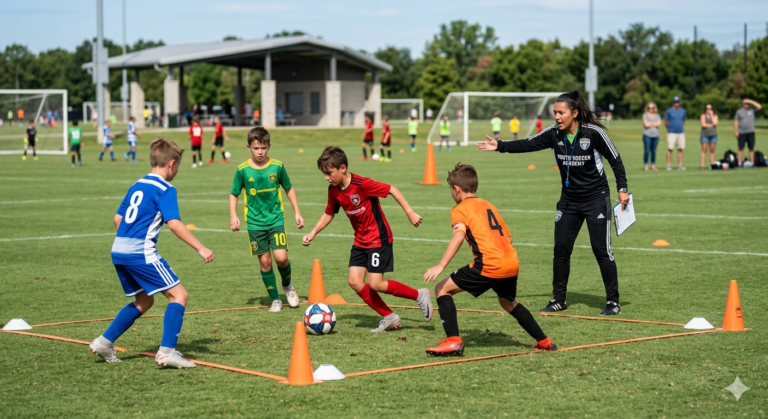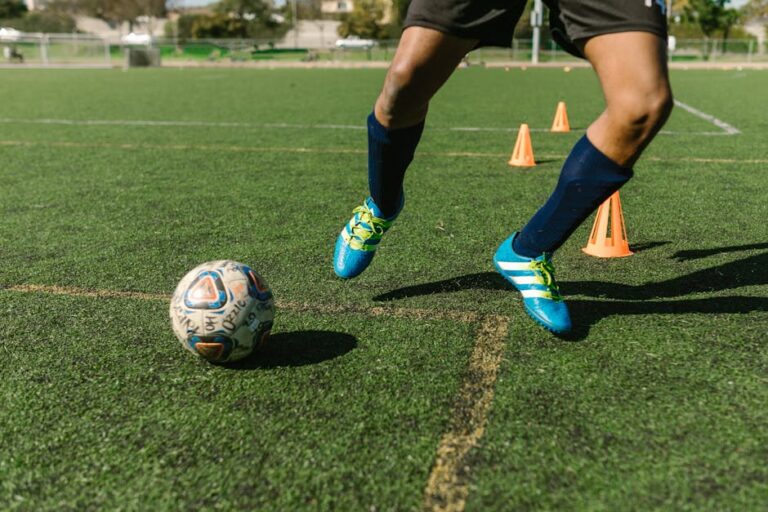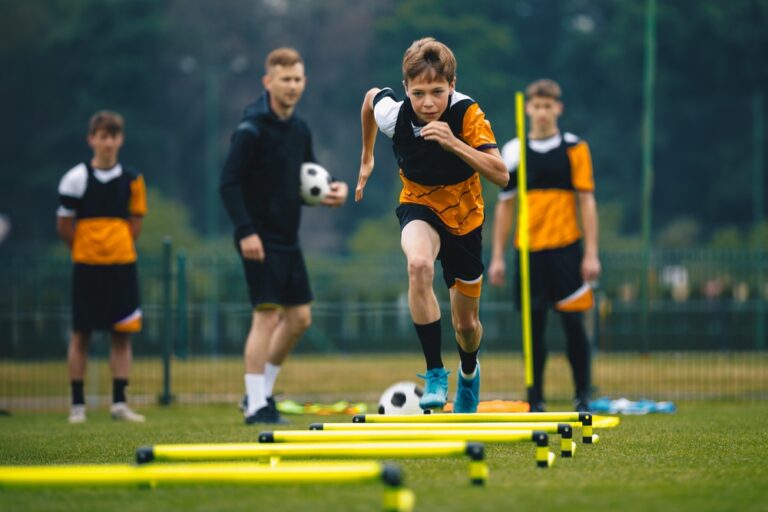


Soccer confidence training is the work nobody puts on a drill sheet, but it’s the thing that decides whether a young player actually shows up on game day or shrinks the moment the pressure turns on. Confidence is not a personality trait — it’s a skill built by reps, by environment, and by the coach’s voice in the player’s head when things go sideways. This guide is what works in real sessions with young players in the Charleston area: what builds confidence on purpose, what kills it without anyone noticing, and how parents can reinforce the right things at home between sessions.
Confidence comes from reps. Not pep talks, not motivational quotes, not promising your kid they’re going to score on Saturday. Reps. The right reps, in the right order, with the right feedback. The rest is noise.
Why confidence collapses in young soccer players
Watch any U10 game in Mount Pleasant and you’ll see the same pattern: a player who looks composed on the training field freezes the second they get the ball in a real match. Their first touch goes long. They turn the ball over. Their head drops. By the second half they’re hiding from the ball instead of looking for it. That’s not a skill problem — they had the skill yesterday. It’s a confidence problem, and it has predictable causes:
- Game speed shock. Practice reps happen at one speed. Game reps happen at another. If a kid only ever trains at practice speed, the first time a real defender closes them down at full speed, they panic. The skill is there — the rep at the right speed isn’t.
- Outcome-only feedback. “Why didn’t you pass?” “You should have shot.” If every adult in the kid’s life only talks about what they should have done, they stop trying anything that might fail. Confidence requires permission to mess up.
- Comparison. The kid sees a teammate doing a move they can’t do yet. They internalize “I’m not good enough.” Real development doesn’t care about the kid next to you — only about whether you’re better than last week. Most parents and a lot of coaches forget that.
- No clear improvement signal. If a young player can’t tell whether they’re getting better, the brain assumes they aren’t. Build feedback loops that show progress — and confidence builds itself.
What actually builds confidence on the ball
Confidence is built in layers. You can’t skip steps, and you can’t fake it. Here’s the layering that works:
1. Build the technical floor first
Confidence requires a baseline of competence the player can rely on. That means hundreds of reps of the basics — first touch in different directions, passing with both feet, simple turns. Boring on its own. But every confident player you’ll ever watch put the work in here first. Aim for 10 minutes of unopposed technical work, daily if possible. Quality reps. Sharp touches. Not just kicking the ball around.
2. Add pressure gradually
Once the player can execute a skill cleanly without pressure, add pressure in stages. A passive defender at first. Then an active defender. Then a smaller space. Then a time limit. Each stage gets uncomfortable for about a week — then the skill clicks at the new level and the kid feels it. That feeling is confidence being built in real time.
3. Train decisions, not just touches
Most youth training overweights technique and underweights decision-making. But confidence in a real game is mostly about decisions — when to pass, when to dribble, when to shoot. Use small-sided games (3v3, 4v4) with constraints to force decisions: two-touch maximum, must combine before shooting, no backward passes. Decision-rich reps build confidence faster than another 100 cone weaves.
4. Let them play under freedom
End every session with free play. No constraints, no coach voice, just kids playing. This is where confidence consolidates — they get to try the things they’ve been working on without anyone watching for the result. The freedom to fail without consequence is what turns a trained skill into a confident habit.
What kills confidence without anyone noticing
Some coaching habits look fine on the surface but quietly erode confidence over weeks and months. Parents — these are the ones to watch for, in your own coaching too:
- Constant correction during play. Yelling instructions every time the ball is at the kid’s foot turns them into a remote-controlled player. They stop trusting their own decisions. Save the feedback for the breaks.
- Sideline coaching from parents. One voice from the coach is hard enough. Adding a second voice from the sideline — even a positive one — overwhelms the kid’s processing. Cheer big moments. Stay quiet during play. Your kid will play more confidently because of it.
- “Just shoot it.” / “Just pass it.” “Just” implies it should be obvious. If it were obvious to a 9-year-old in real time, they’d have already done it. Drop the word “just” from your soccer vocabulary.
- Comparing to other kids out loud. “Why can’t you do what Liam does?” never built confidence in anyone, ever. Compare the kid to last-month’s version of themselves. That’s the only comparison that helps.
The parent’s job: build the off-field environment
Most of soccer confidence is built between sessions, not during them. What happens in the 23 hours a day the player isn’t on the field matters more than what happens in the 1 hour they are. The parent’s job, on the confidence side, is short:
- Ask “did you have fun?” before “how did you play?”
- Praise effort, not results: “I saw you keep trying that move — that’s how you get better.”
- Let the post-game car ride be quiet unless they want to talk. Don’t run a debrief.
- Reinforce that mistakes are how the brain learns. Every confident player makes mistakes every game — the difference is they keep playing.
A composed, confident player on Saturday is almost always a player whose parents and coaches built an environment where mistakes weren’t expensive emotionally. That’s the actual work.
FAQ — Soccer confidence training
How long does it take to build real soccer confidence in a young player?
Visible change usually shows up in 4-6 weeks of consistent training plus a supportive environment. Lasting confidence — the kind that holds up under pressure in big games — usually takes a season or more. The faster path is doing the right things consistently; the slower path is doing the wrong things every other day.
My kid is afraid of the ball during games — what should I do?
Fear of the ball is almost always game-speed shock plus too much consequence around mistakes. Drop the post-game performance talk for a month. Get them more 1v1 and small-sided reps at real speed, so the game stops feeling foreign. Their confidence comes back when the speed stops surprising them.
Does private soccer training actually help with confidence?
Yes — when it’s run right. Private sessions can be high-rep, no-comparison, immediate-feedback environments — exactly the conditions confidence needs. They can also be the opposite if the coach is corrective and outcome-focused. Ask any prospective trainer how they coach mistakes. The answer tells you whether their sessions will build confidence or chip away at it.
What’s the difference between confidence and arrogance in a young player?
Confident players keep working. Arrogant players stop working because they think they’ve arrived. Real confidence in a young player includes humility — they know what they’re good at and what they’re working on. If your kid is starting to coast, that’s not confidence, that’s complacency. Different problem, different fix.
How do I know if my child’s coach is building or hurting their confidence?
Watch how the coach talks to the kid who just made a mistake. If the response is technical and short (“next time look up before you pass — let’s see it again”), that builds confidence. If the response is loud, public, or sarcastic, that chips it away. The tone after a mistake is the entire signal.
Confidence through reps. Train with purpose.
Confidence is not built in the locker room speech. It’s built in the boring 10-minute technical block, in the small-sided game where the kid finally pulls off the move they’ve been working on, in the coach’s voice that stays calm when they mess up. Do those things consistently and you’ll watch a young player walk onto the field different by the end of the season.
If you want to talk through where your player’s confidence is plateauing and what would actually help — head to the contact page. For more on the mindset side of youth soccer, see why your child needs a soccer brain and why mindset matters more than goals. If you’re trying to figure out how 1-on-1 sessions specifically affect confidence, our guide to picking a private soccer coach in Charleston goes deeper.