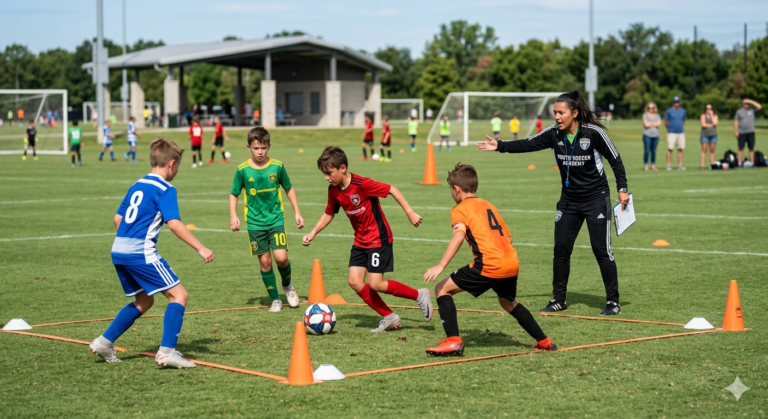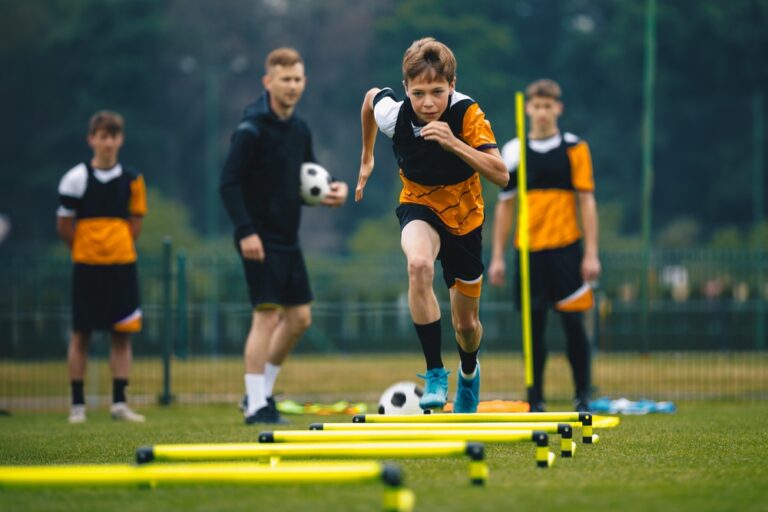


Good soccer warm-up drills do three things: raise the heart rate, wake up the muscles a player is about to sprint on, and get their touch sharp before the whistle. Twenty minutes is plenty. What you don’t want is the thing I still see every Saturday in Charleston — a line of kids doing static stretches, then jogging out flat and needing ten minutes of the first half to find the game.
I’m Olly. I play for Surf and coach younger players around Mount Pleasant. This is the warm-up I use, why each part is there, and what to cut when you only have ten minutes because the game before ran long.
Why the warm-up matters more than people think
Two reasons, and the second one is the one nobody talks about.
First, injury. Cold muscles going straight into sprints and changes of direction is how you pull something. A proper warm-up gradually raises body temperature and takes joints through the range of motion they’re about to use.
Second — and this is the one that actually shows up on the scoreboard — confidence. A player who has already taken forty clean touches before kickoff walks onto the field expecting the ball to stick. A player whose first touch of the day happens in the third minute under pressure is playing catch-up. Confidence comes from reps, and the warm-up is free reps.
The 20-minute warm-up, block by block
Block 1 — Movement, 5 minutes
Start easy and build. No static stretching yet — that comes after, if at all.
- Two minutes of easy jogging across the width of the field
- High knees, heel flicks, side shuffles, open the gate, close the gate
- Two or three gradual build-up runs — 60%, then 80%, then close to full
By the end of this block a player should be warm and slightly out of breath. If they’re still cold, the warm-up hasn’t started yet.
Block 2 — Ball mastery, 5 minutes
Every player on a ball, working in a small space. This is the block most teams skip and it’s the one I’d protect hardest.
- Toe taps and sole rolls — 30 seconds each
- Inside-inside touches moving forward and back
- Sole roll and push across the body, both directions
- Quick figure-eights around the feet
Keep the touches quick and light. The goal here isn’t fitness, it’s waking up the feet. Ten seconds of sloppy touches undoes the point. If your player wants to get properly sharp at this, it’s the same work as first touch drills you can do in a backyard — five minutes a day beats an hour once a week.
Block 3 — Passing in pairs, 5 minutes
Partner up, eight to ten yards apart, and build up:
- Two-touch passing — receive, set, pass. Focus on the first touch going forward, not sideways.
- One-touch passing for 60 seconds. It’ll be messy at first. That’s the point.
- Step it back to 15 yards and hit driven passes along the ground.
- Finish with a few short lofted passes and controls out of the air.
Weight of pass is what I’d coach here. A pass that arrives too hard makes your teammate look bad. Details matter.
Block 4 — Speed and shape, 3 minutes
Short, sharp, full effort — but only a few reps. This is priming, not conditioning.
- Three or four 15-yard sprints from a standing start
- A couple of change-of-direction reps — sprint five, cut, sprint five back
- Two quick jumps, landing softly
If a player is gassed after this block, it was too long. They should feel switched on, not tired. This kind of sharpness is trainable outside of game day too — it’s the core of agility training for young players.
Block 5 — Finishing and a last touch, 2 minutes
Finish on something that feels like the game. A few shots on the keeper, or a quick 3v1 rondo. Something with a bit of noise and competition in it.
Then water, and get them focused. The last thirty seconds before walking out should be quiet, not frantic.
The 10-minute version
The game before overran. It happens constantly. Cut in this order:
- Keep: 3 minutes movement and build-up runs. Non-negotiable — this is the injury-prevention part.
- Keep: 3 minutes ball mastery. Cheap, fast, and it’s where the confidence comes from.
- Keep: 2 minutes passing in pairs.
- Keep: 2 minutes sprints and one finishing rep.
You lose volume, not structure. What you never cut is the gradual build to full speed.
Soccer warm up drills to stop doing
- Long static stretches before kickoff. Holding a hamstring stretch for 60 seconds before you sprint doesn’t help performance and may hurt it. Save the long holds for after.
- Standing in a shooting line for ten minutes. Twelve kids, one ball, one shot each. Almost no warming happens.
- A full-intensity scrimmage. Players arrive at kickoff already tired.
- Nothing at all. Turning up eight minutes before kickoff and walking on cold is the most common mistake in youth soccer.
The Charleston heat factor
Worth saying plainly, because September here is still hot and humid. On a 90-degree afternoon, shorten the running blocks and lengthen the ball work — a player can get sharp on the ball without cooking themselves before kickoff. Get shade between blocks, and make sure they’ve been drinking water for hours before the game, not just at the field.
What they eat matters here too, and the timing matters more than the food. What to eat before a game or practice covers that properly.
FAQ
How long should a soccer warm-up be?
Fifteen to twenty-five minutes for youth players, finishing about five minutes before kickoff. Long enough to get properly warm, short enough that they don’t cool down again before the whistle.
Should young players stretch before a soccer game?
Dynamic movement — high knees, leg swings, build-up runs — yes. Long static stretches held for 30 to 60 seconds are better saved for after the game, when the goal is recovery rather than performance.
What are the best warm-up drills for youth soccer?
A gradual movement block, ball mastery on an individual ball, two-touch and one-touch passing in pairs, a few short sprints with a change of direction, and a small competitive finish. That sequence covers everything the game will ask for.
How soon before kickoff should the warm-up finish?
About five minutes. Enough time for water, a team talk and a breath — not enough time to go cold.
Do goalkeepers need a different warm-up?
Yes. Keepers need handling, footwork, and progressively harder shots — starting close and gentle, building to game-speed. They should join the team movement block, then break off for keeper-specific work.
Can players warm up on their own before they get to the field?
Absolutely, and the good ones do. Five minutes of ball mastery in the driveway before you leave means arriving with your touch already awake.
Train the way you want to play
A warm-up isn’t a formality. It’s the first twenty minutes of your performance. Players who take it seriously start games sharp — and starting sharp is often the whole difference in a 40-minute youth game.
If your player wants to build the technical foundation that makes all of this easier, get in touch about a session. We’ll work on the things that show up on game day.
About Olly: Oliver “Olly” Sovenyhazy is a 16-year-old soccer player with Surf and a volunteer with the professional Charleston Battery. Through Olly on the Ball he coaches private, semi-private and small-group sessions for young players across Mount Pleasant and the Charleston area — building confidence through reps, and skills that hold up in real games.