

Defensive soccer drills for kids almost never get the attention attacking drills do — which is exactly why training defending well is one of the biggest unfair advantages a young player can build. Most youth practices spend 80% of the time on shooting, dribbling, and finishing. Defending gets a few minutes at the end if there’s time. Coaches at higher levels notice the players who can actually defend, because they’re rare. This guide is a practical breakdown of how to train confident defenders for ages 7-14 — what the actual skills are, what drills build them, and how to develop the mindset that turns defending from “the boring position” into a competitive edge.
The pattern shows up consistently in youth soccer: the kid who tracks runs, closes down passing lanes, and isn’t afraid of a real 1v1 challenge becomes the kid every coach wants on their roster. Defending is also one of the most confidence-building positions in soccer when trained correctly — there’s a clarity to “stop the attack” that builds composure fast.
The four core skills of youth defending
Every defending skill in soccer rolls up into four trainable categories:
- Body position — staying goal-side, jockeying with knees bent, shoulders square to the attacker, weight on the balls of the feet ready to react in either direction.
- Closing speed and angle — knowing when to sprint at an attacker and when to slow down. Closing too slow gives the attacker time. Closing too fast and head-down gets the player beat on the first move.
- Timing the tackle — most young defenders dive in too early. The skill is staying patient, forcing the attacker into a bad touch or a sideline, then winning the ball cleanly when the moment opens up.
- Reading the game — anticipation, scanning, recognizing where the next pass is going to be played and getting there first. This is the highest-ceiling defending skill and the hardest to train.
Drills below build all four — start with the simple ones for younger players, layer the more complex ones in as the foundation locks.
Drill 1 — Jockey and shadow (ages 7+)
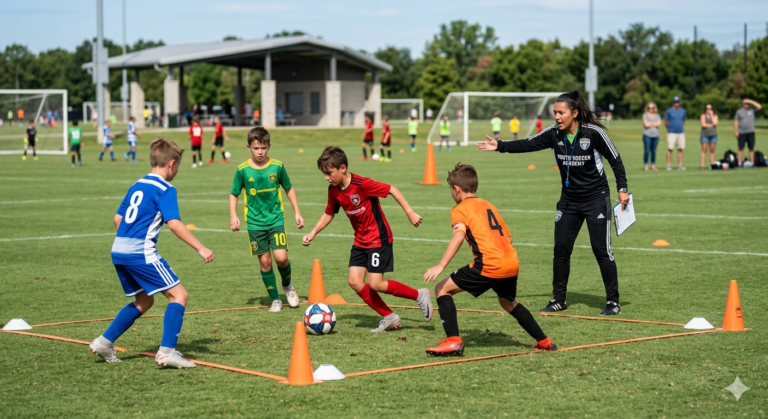
The simplest body-position drill. You need: two players, a ball, a 5-yard wide channel marked by cones.
How: Attacker stands at one end of the channel with the ball. Defender stands 3 yards in front, sideways stance, knees bent. Attacker dribbles slowly forward; defender shuffles backward staying goal-side. No tackling — just mirroring. Switch after 30 seconds. 4-6 reps per player.
What it builds: stance, balance, foot speed in lateral movement. Boring but foundational. Without this, the higher-level defending skills don’t have a base to sit on.
Drill 2 — 1v1 to a small goal (ages 8+)
The core defending drill. You need: two players, a ball, two small goals (cones, water bottles), a 15-yard area.
How: Attacker tries to dribble the ball past the defender and score in a small goal behind them (or just over a line). Defender wins if they steal the ball or force the attacker out of bounds. 30-second rounds. 5 rounds per matchup, then switch.
Coaching cues for the defender: show the attacker one direction (force them onto their weak foot), don’t dive in, wait for the bad touch, win the ball with the foot closest to the attacker.
What it builds: closing angles, patience, timing, and confidence in 1v1 situations. The single most important defending drill at every age.
Drill 3 — Channel defending (ages 9+)
Adds decision-making to 1v1 defending. You need: two players, a ball, a 10-yard wide x 20-yard long channel.
How: Attacker dribbles from one end of the channel toward the other. Defender starts in the middle. The channel walls force the attacker into predictable spaces — defender’s job is to read which side the attacker will commit to, close that angle, and force them out of bounds or steal the ball. 30-second rounds, switch.
What it builds: reading attacker body shape, committing to the right angle, using the sideline as a “second defender.” This drill is where defending starts to feel like thinking, not just running.
Drill 4 — Recovery defending (ages 10+)
Trains the under-trained skill of defending while behind the play. You need: two players, a ball, a 20-yard channel with a goal at one end.
How: Attacker starts with the ball 15 yards from goal. Defender starts 5 yards behind the attacker, facing the same direction. Coach yells “go.” Attacker sprints toward goal trying to score. Defender has to recover, catch up, and stop the shot before the goal line. 5-6 reps per matchup.
What it builds: recovery sprint mechanics, defending while not in ideal position, deciding when to tackle vs. when to just disrupt the shot. This is the drill every youth defender needs more of and almost nobody gets.
Drill 5 — Read-the-pass (ages 11+)
Reading the game work. You need: three players, a ball, a 15×15 yard area.
How: Two attackers pass between themselves. A third player (the defender) starts in the middle, can’t tackle until they intercept a pass with a clean read. Defender’s job: scan, anticipate, and step into the passing lane before the pass arrives. If the defender intercepts, they become an attacker; one of the attackers becomes the defender. 3-minute rounds.
What it builds: the anticipation skill that separates good defenders from elite ones. Defenders who read the next pass are years ahead of defenders who only react after the pass.
How to build the defender’s mindset
Skills are half the story. The other half is the mental side — and it’s the half coaches don’t usually train on purpose:
- Defending is brave, not boring. Reframe the position language at home and at training. The defender is the player who wants the responsibility of stopping the attack — that’s a competitive identity, not a consolation prize.
- Patience is a defending skill. Most young defenders feel like they have to do something — that’s how they get beat. Train the discipline to stay on the balls of their feet, watch the attacker’s first touch, and react to the bad one. Patience builds confidence.
- Communication is part of defending. The best defenders talk constantly — to teammates, to themselves, to organize the back line. Encourage your player to talk on the field. It’s a defending skill as real as any tackle.
- Defending failures are recoverable. A missed tackle is one play. A defender who shakes off a beat-on-the-dribble moment in 3 seconds and gets back into the play is more valuable than a defender who never gets beat but spirals when they do.
How parents can reinforce defending at home
- Play 1v1 in the backyard with the rule “the parent has to dribble past you.” Low-pressure reps build defending confidence faster than anything organized.
- Watch real defenders together. Pick a top center back or fullback in MLS or the Premier League. Watch them for 10 minutes — what they do off the ball, how they position, how they communicate. Defending highlights are rare on TV; intentional film watching fills that gap.
- Praise defending in conversation. If you only talk about goals after games, your player learns goals are what matter. If you mention “that tackle in the second half — good read, great timing” the message lands that defending matters.
- Don’t let defending become a punishment position. If the only time the coach moves a kid to defender is when they’re not performing, defending becomes associated with falling short. Better youth coaches rotate positions broadly so defending becomes a normal skill set every player builds.
FAQ — Defensive soccer drills for kids
At what age should kids start learning to defend?
Basic defending concepts (stand between attacker and goal, don’t dive in) can start at ages 6-7. Structured defending drills with body position cues land well at ages 8+. Higher-level work — recovery defending, reading-the-pass — is best at 10+.
My kid hates playing defender — what should I do?
Usually one of two things: either they associate defender with “less fun” because they’re not getting the ball, or they associate it with “punishment” because that’s when the coach moves them. Reframe at home: defending is a chance to read the game, win the ball back, start the attack. Find a defender they admire and watch a game together. The position identity usually shifts when the framing does.
How often should defensive drills be in a young player’s training week?
Every training session should include some defending — even 10 minutes of 1v1 work. Defending isn’t a separate skill for one player on the team; it’s a base skill every player needs.
What’s the most common mistake young defenders make?
Diving in too early. Young defenders feel like they have to act, so they lunge at the first opportunity — and get beaten on the first move. Patience, stance, force the attacker into a bad touch, then steal it. That sequence has to be trained explicitly because the default instinct goes the other way.
Can defensive training help with overall soccer development, not just for kids who play defender?
Yes — significantly. Players who defend well attack better because they understand what defenders are doing on the other side. Strikers who’ve been defenders know how to attack the gaps. Midfielders who’ve defended understand pressure traps. Defending is foundational to whole-field soccer IQ.
Confidence behind the ball.
Defenders win games. They just don’t get the highlight reels. The young players who learn to read the game, time their tackles, and bring real competitive energy to defending become the players coaches build teams around at every level. The drills above are simple, scalable, and high-leverage — start with the foundation, layer in the harder reads as the player gets comfortable, and watch a defender emerge who’s quietly more valuable than the kid scoring twice a game.
If your player wants focused work on defending — alone or in small-group sessions in Mount Pleasant or the Charleston metro — head to the contact page. For more on drills, see beginner soccer drills — everything you need to know, from goalies to forwards — drills for every kid, and building a human wall on the pitch. For the soccer IQ work that pairs perfectly with defending fundamentals, read our companion soccer IQ training guide.